
When you travel to Hong Kong, your first impression of the city is one of sheer awe and fascination. As the airplane circles over the city, aligning with the landing strip, you are left to admire nothing but the South China Sea, mountains, rivers, and skyscrapers. A lot of skyscrapers. Nothing but… skyscrapers.
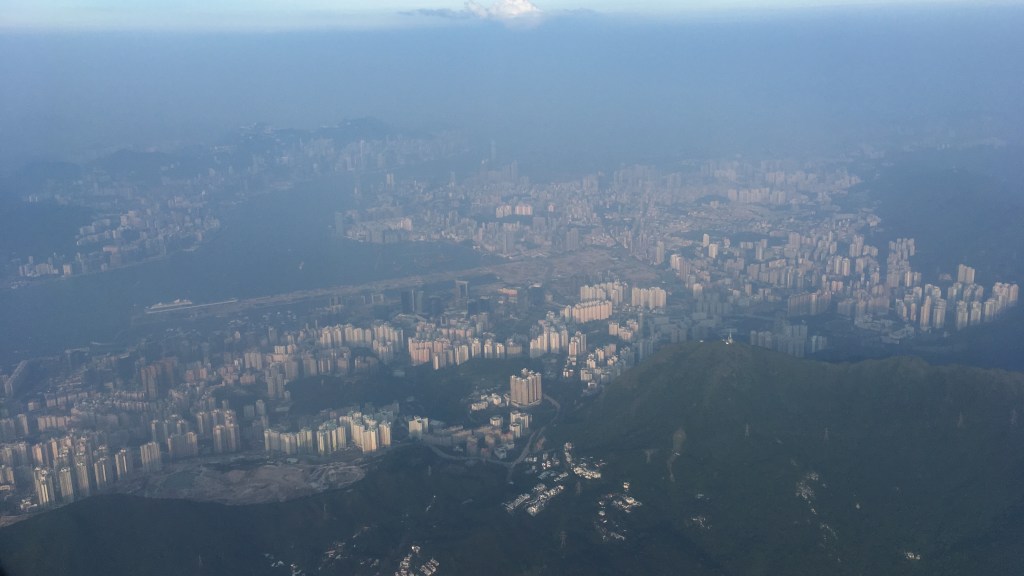
No other city in the world offers such a view. Of course, New York City is famous for its skyscrapers. But leave Lower Manhattan, and buildings quickly reach a much more reasonable size. Los Angeles is known for stretching for miles on end in every direction. But leave downtown LA, and you’ll only see two or three-story-high buildings.
You will not see anything of the sort in Hong Kong. What you will see, in Hong Kong, are rows upon rows of gigantic, tightly-packed-together buildings. Industrial, Commercial and Residential alike.
This unique mix of skyscrapers and… well, more skyscrapers, has given Hong Kong Island one of the most iconic skylines in the world: Bank of China Tower, HSBC Tower, Two International Finance Centre (better known as 2IFC or simply IFC), the Hong Kong Convention and Exhibition Centre (HKCEC). All of those buildings are surrounded by other colossal -yet less spectacular- towers.
Alas, none of those buildings were designed by Hong Kongers. One might, of course, argue that Ieoh Ming Pei, the designer of the Bank of China Tower, was partly raised in Hong Kong. But the fact is that he was born in Guangzhou, in the -then- Republic of China (not to be confused with the People’s Republic of China). And he studied architecture at the University of Pennsylvania, the Massachusetts Institute of Technology (MIT), and Harvard University. All of which are located in… the United States of America. As a matter of fact, I.M. Pei died an American citizen, in 2019, and didn’t hold a Chinese passport of any sort.
It would be unfair and untrue, however, to claim that Hong Kongese architects haven’t played any role in the shaping of the skyline of Hong Kong Island. For better or -usually- worse. In that regard, two buildings make a defining impact on the skyline of Hong Kong: Central Plaza (by Dennis Lau and Ng Chun Man Architects and Engineers), located in Wan Chai, with its vulgarly gilded window-panels; and the horrendous People’s Liberation Army Forces Building (designed by Pun How Wai), located in Admiralty.

On the Kowloon side of Hong Kong, on the other hand, only two buildings really stand out from an architectural point of view: The International Commerce Center (or ICC), and the Hong Kong Cultural Centre. One was designed by an American architecture firm (KPF); the other one, brainchild of the Architectural Services Department of Hong Kong, has been defacing the Kowloon side of Victoria Harbour since 1989. I’ll let you find out which firm was responsible for the monstrosity in Tsim Sha Tsui.
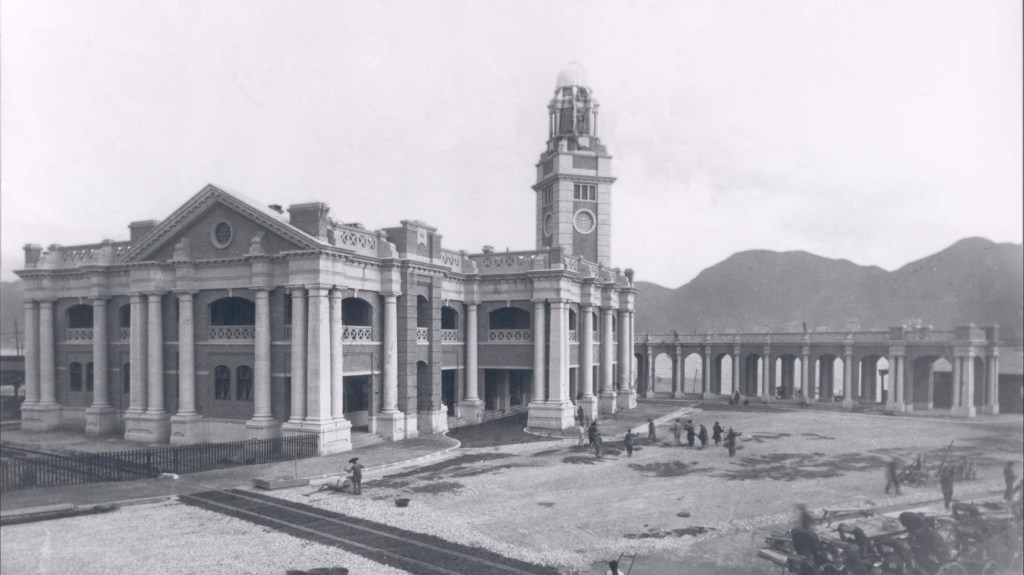
In the meantime, let’s talk some more about said monstrosity. And yes, obviously, as you guessed, that building was designed by the Architectural Services Department of Hong Kong. To add insult to injury, the construction of this unsightly piece of concrete garbage required the demolition of an architectural jewel: the Kowloon Railway Station. To give you an idea of the style of the building that was lost, look no further than the Clock Tower in Tsim Sha Tsui, its only present-day remnant. And compare it with the building that now stands behind it. To think that the mesmerizingly appalling Hong Kong Cultural Centre was designed to host some of the most beautiful pieces of art is quite ironic.

Talking about the Kowloon skyline, one must mention two more buildings that stand out due to their sheer size and location: the Victoria Dockside and the Masterpiece. The design of the first mentioned building was led by American architecture firms KPF and James Corner Field Operation. Neither exceptional nor an eye-sore, it just stands there, unavoidable and uninteresting on Kowloon’s shoreline.
The inaptly named Masterpiece (the name itself is quite an exercise in vanity and vulgarity), however, was designed by Dennis Lau and Ng Chun Man Architects and Engineers. Similarly to the Victoria Dockside, it bears no striking features, and just stands there, in all its tall and insignificant -lack of- glory.
All those buildings -beautiful and ugly alike- only represent a minuscule fraction of the real-estate in Hong Kong. But, compared to residential buildings, one must salute the creative effort put in those buildings. Yes, even in the Cultural Centre. Now, focusing on the residential estate, Hong Kong truly deserves its title of concrete jungle as the vast majority of buildings in the city are little more than that: concrete cubes pierced with windows.
Architects and engineers don’t even bother to hide pipes, which are placed on the outside of the buildings for everyone to enjoy. And if that was not enough, owners and tenants add the final touch to this horror by sticking air-conditioning units directly onto the windows. Better still, on modern buildings architects design ledges specifically for that purpose. Practical? Definitely. Beautiful? I’ll let you be the judge of that.
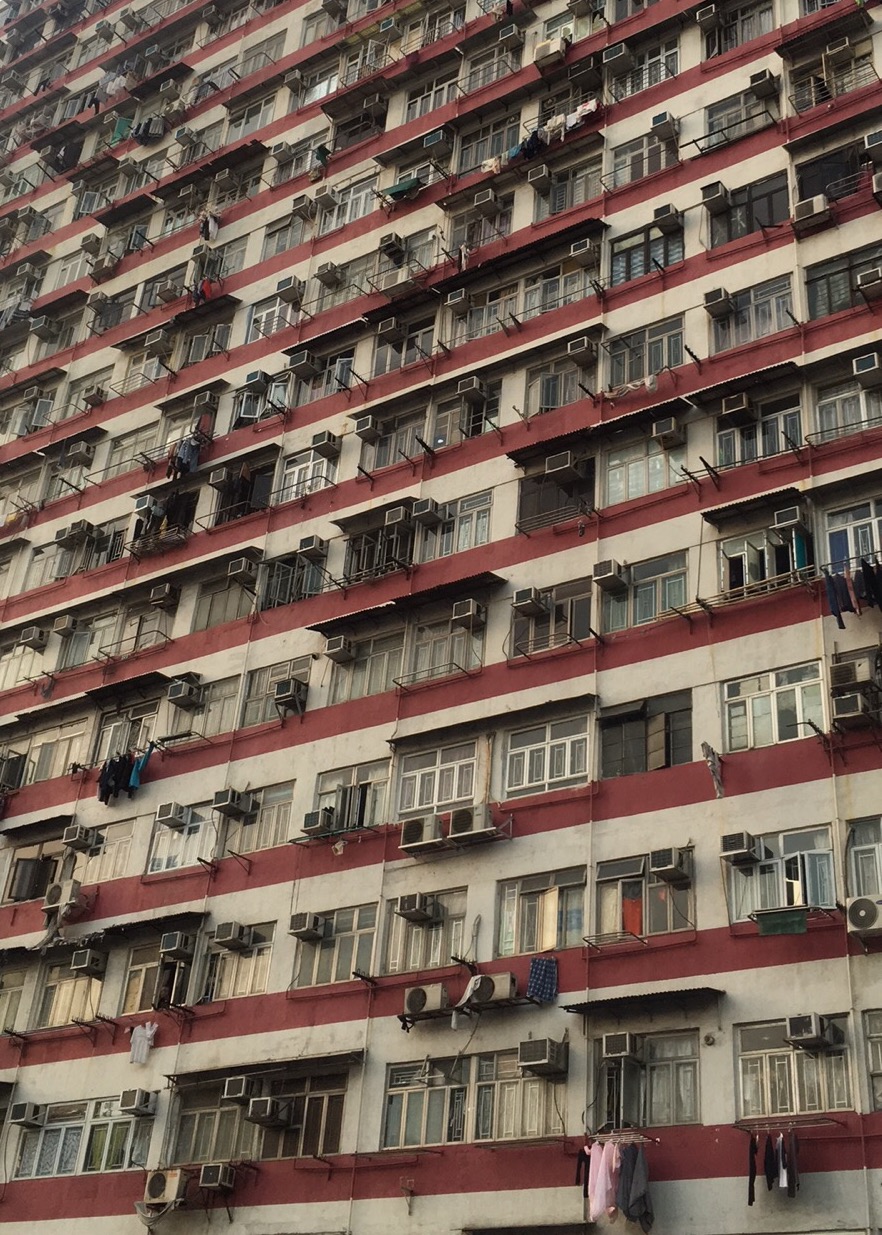
Now, one might think that this is only the case in the poorer districts of Hong Kong, such as Sham Shui Po or Kwun Tong. After all, aren’t all poorer areas in the world uglier than the wealthy ones? Well, yes, it is true to some extent. But not in Hong Kong. Whether you go for a walk in Kwai Tsing (third poorest district in Hong Kong) or in Mid-Levels (one of the poshest neighborhoods), the buildings are equally ugly. Bear in mind that we are solely talking about architectural ugliness, here. Rich areas remain (much) cleaner and less chaotic (kinda) than poorer ones. But the fact remains that, rich or poor, Hong Kongers simply have no clue on how to design beautiful buildings.

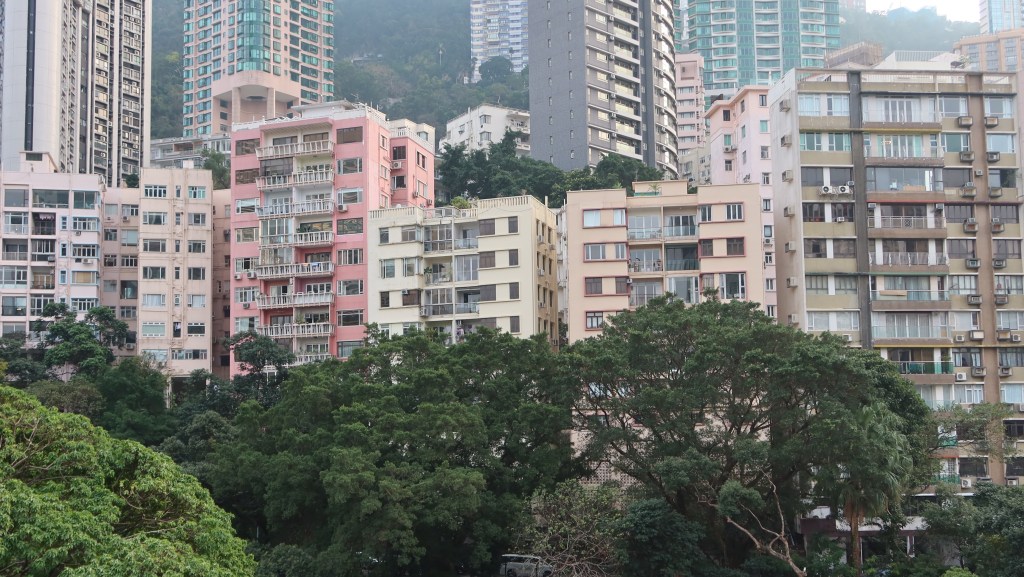
Even the wealthiest area in the city, namely The Peak, isn’t impervious to the ambient blandness of the city. Extremely wealthy Hong Kongers do not hesitate to splash in excess of a billion dollars (HKD) on real-estate on the Peak. And what do they get for that price? Well, remember the concrete cubes pierced with windows I mentioned earlier? That’s what they get. Only bigger. And on premium land.
Sure, beauty is in the eye of the beholder, but give a look at the $1.25 billion HKD houses in the photograph below. They’re all the same featureless cubes! I mean, seriously, wasn’t there enough money, in those $1.25 billion HKD, to hire an architect to design houses with more architectural gusto and/or personality? Oh, wait… It was designed to appeal to the wealthy? Well… like I said… beauty is in the eye of the beholder, isn’t it?
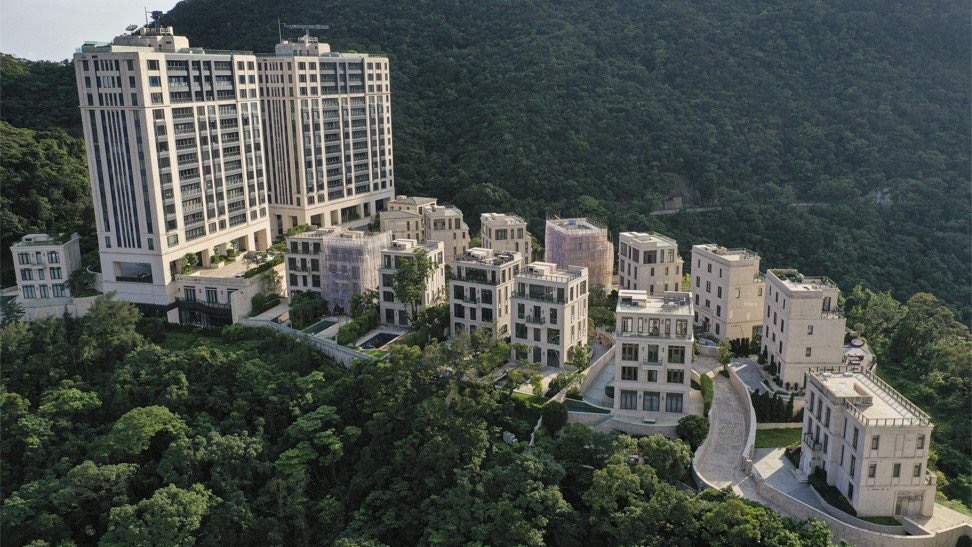
This shows the general state of mind prevalent in the city. See, Hong Kongers think primarily in terms of money. Creativity and imagination didn’t just take a backseat in Hong Kong; they were left behind on the sidewalk to be trampled by the masses. Think of it, the most common New Year’s greeting in Cantonese (恭喜發財; kung hey fat choy) literally means “Congratulations for becoming rich”. It doesn’t get any more explicit than this. Now, think a bit further. Will a beautiful building generate more money than an ugly one? No. In this case, who gives a fuck about designing a nice-looking building?
This transpires best in the public housing sector. Whether you are in Tung Chung (West of Hong Kong) or in Chai Wan (East of Hong Kong), all public housing estates are based on the same blueprint. This enables contractors to pre-fabricate entire storys and pile them up one on top of the other, like Lego. And in less than a year an entirely new neighborhood has sprung out of the dirt, identical to all other public-housing neighborhoods in Hong Kong.
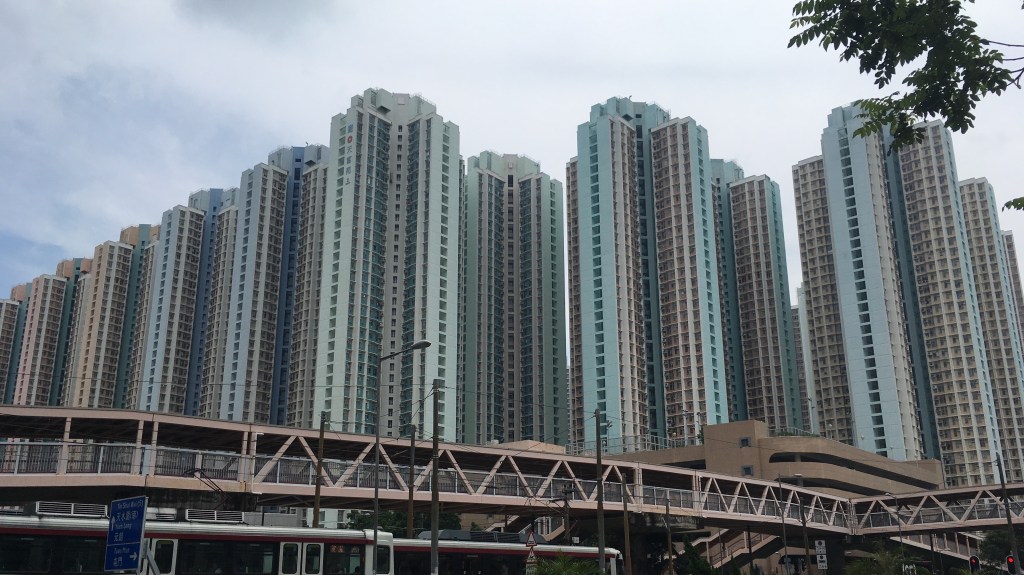
In this regard, Hong Kongers are extremely efficient. But then again, building crap has always been quick. Especially when you’re merely copy/pasting ad nauseam. This way of building has turned Hong Kong into a bland and boring city to look at. And it seems Hong Kongers haven’t understood yet that living in a nice environment improves your quality of life. But this being Hong Kong, who gives a fuck?
 Gweilo Rant
Agree, no creativity at all. Lazy, for people who think so highly of themselves, they seem to enjoy accepting mediocrity on every aspect in life
LikeLike
As you say, beauty lies in the eye of the beholder. When Europeans first saw Australia they were appalled at its unrefined nature; after living there they came to appreciate it’s unique charms. After 20+ years in this part of the world, I find the Tong Lou architecture very pleasing to the eyen and the patina of the concrete jungle fascinating. Even the massive estates with 20+ identical towers are astonishing. Yes, they are not as creative in design as we’re now seeing in China, for instance; but I would argue that the main difference between hk and Shenzhen is not so much the building stock but the landscape gardening, which is much more lush across the border. I do appreciate what you’re saying, but think it’s lacking in comparative examples. It would be useful for u to provide us with an idea of what you consider good models of unfugly urban architecture. Thanks.
LikeLike