HONG KONG – So Much (Untapped) Potential

Bank of China Tower and ICBC Tower seen from Hong Kong Park. Central, Hong Kong Island. 21 January 2020. Photo: Gweilo Rant.

In the 1950s, there was a small 20,000-inhabitant town stuck in the desert, on the shores of the Persian Gulf. Other than trading activities derived from its strategic location, at the crossroads between Europe, the Middle East, and India, that small town had very little to capitalize on.

Yet, a visionary and ambitious sheikh pushed the development of that small town. When oil was discovered in the territorial waters of that little town, in the late 1960s, development accelerated. An airport, a deep-water port, schools, hospitals, roads, touristic infrastructures,… That small town got it all.

Seventy years later, in 2020, that small town had grown into an exuberant 3,331,000-inhabitant megalopolis; home to the tallest skyscraper in the world, three sets of islands reclaimed on the sea in the shape of palm trees, one of the most exclusive hotels in the world, and many more extravagant projects. That small town was Dubai.

Which brings us to another small city that took advantage of its geographic location: Singapore. Located on the Southern tip of the Malaysian peninsula, Singapore is sitting right on the maritime route between the Far East, India, South East Asia, and the Middle East (hence, Europe).

After a rather chaotic start, in the late 1950s and early 1960s, Singapore finally took off under the impulse of its first Prime Minister, Lee Kuan Yew, who understood Singapore’s full potential better than anyone else. Notwithstanding a complete lack of natural resources, Singapore initially focused on its manufacturing sector, as well as on education, on which it capitalized. Hard.

In the 1980s, Singapore knew a Golden Age with unemployment rates falling to 3% whilst its GDP recorded a yearly growth averaging 8%. Changi Airport was inaugurated in 1981 and Singapore Airlines, founded in 1985, grew to become a major global airline company. Meanwhile, the port of Singapore became the busiest port in the world (until 2010) thanks to its prime location and wise investments.

Although not as extravagant as Dubai, twenty-first century Singaporeans have built some stunning architectural marvels such as the Marina Sands Resort, Gardens by the Bay or Merlion Park. However, whilst the city grew, Singaporeans were wise enough to preserve their historic assets, such as Kampong Glam, Chinatown, or the Old Parliament House, for instance. 

This naturally brings us to the topic of this article: Hong Kong. And what a shame this city is. Dubai and Singapore capitalized almost entirely on their strategic location, which gave rise to iconic twenty-first century cities. Yet, to this day, it is still Hong Kong that enjoys the very best geographic and socio-eco-political situation in the world (thanks to the Westerners lacking a backbone and not reacting to the PRC’s blatant violation of the Sino-British Agreement of 1984, the National Security Law will have very little effect on the economy of the city).

Unfortunately, Hong Kongers failed and still fail to take advantage of Hong Kong’s prime situation. Well, to be more precise, Hong Kongers didn’t exactly fail; they simply are unaware of the ridiculously high potential of their own city.

If you look at a map of Asia, you’d soon notice that Hong Kong was built on the Southern tip of what has become the PRC’s (and the world’s) technological factory: Shenzhen and Guangdong Province. Not only that, Hong Kong also sits smack in-between Japan, South Korea, Shanghai, and Taiwan in the East, and Malaysia, Singapore, Thailand, India, and the Middle East (hence Europe further up) in the West.

Yet, however incredible it may sound considering Hong Kong’s near-perfect situation, the city managed to lose its role as busiest port in Asia when it was surpassed by the likes of Shanghai and Ningbo-Zhoushan -both of which not ideally located on the far eastern shore of the PRC- or Singapore and even… Shenzhen.

Now, this last one particularly hurts considering Hong Kong is a free market, which the PRC is not. Yet, regardless of this handicap, the port of Shenzhen was built from scratch only a few kilometers from the port of Hong Kong and, in less than fifteen years, managed to surpass the port of Hong Kong. Good job, Hong Kong.

Now, if you give a closer look at the economy of Hong Kong, you’d notice that it is almost entirely based on the finance industry. Hong Kong doesn’t produce anything, hence doesn’t export anything. Or so little. Hell, it is not even capable of acting convincingly as the middle-man between Communist PRC and the rest of the world when it comes to exporting Chinese goods.

Even though a key financial place in Asia, Hong Kong is not able to capitalize on its experience and on the fact that it is the only free market in China. Look at the evolution of the stock-exchange market. In 2020, Hong Kong lost its spot as third most important financial center in the world (due in part to the protests) to the benefit of Tokyo. And Shanghai. And Singapore. Yes, you read right. Hong Kong lost three spots in just one year, falling from the third spot to the sixth spot. And Beijing and San Francisco are ready to overtake Hong Kong in the next couple of years as well. Amazing job, Hong Kong.

GFCI 27 Top 20 Ranks And Ratings. March 2020. Source: The Global Financial Centres Index 27.

To make matters worse, Hong Kongers are not even capable of developing their own finance industry. Of course not. Rather, Hong Kong’s finance industry almost entirely relies on foreign banks. I mean, how many Hong Kongese banks could you name? A few? And how many of those Hong Kongese banks have grown to become multinationals? None! Zero!

Hong Kong’s highest ranking bank, Hang Seng Bank, was ranked 82nd globally in the 2019 Brand Finance Banking 500. And it has branches in Hong Kong, the PRC, and Macau only… after an 87-year-long existence. Even Singapore’s DBS (ranked 34th in the 2019 Brand Finance Banking 500) has grown to be present all over South-East Asia. And it was founded only 51 years ago! In fact, two more Singaporean banks ranked higher than Hang Seng Bank: UOB (55th) and OCBC Bank (56th).

This reliance on foreign investors, in Hong Kong, led to some tense months when, in the midst of the 2019-2020 Hong Kong Protests, foreign investors began to think about relocating their activities. Try to imagine the consequences on the Hong Kongese economy if foreign banks left the city.

Since we were studying the Brand Finance rankings, how about we gave a look at the 2020 Brand Finance Airline 50? And, surprise, Hong Kong doesn’t score well in that department either (relative to Dubai and Singapore). In 2020, Dubai-based Emirates was the 4th highest valued airline in the world (1st non-American airline). Singapore Airlines ranked 20th. And Hong Kong-based Cathay Pacific ranked only 28th. Considering Hong Kong’s ideal geographic situation, right in the middle of the Asia-Pacific region, it is rather astounding Cathay Pacific never capitalized on Hong Kong’s prime location.

Top 30 most valuable airline brands. April 2020. Source: Airlines 50 2020.

Think about it, Hong Kong could be a major passenger hub between Japan, South Korea, Taiwan, the PRC, India, Singapore, South-East Asia, Australia, and New Zealand. Yet, again, Dubai ranks 5th globally whilst Hong Kong only ranks 13th. Luckily, Singapore hasn’t beaten Hong Kong yet, as it only ranks 17th. Even Chinese airports (Beijing, Shanghai, and Guangzhou), with all their rules and restrictions, rank higher than Hong Kong (sure, domestic flights in a country with 1.4 billion inhabitants help a lot).

It is simply astonishing Hong Kong ranks so low as a passenger-hub. Even more so considering Hong Kong has proven its potential as a major cargo-hub. And not just any major cargo-hub. Shek Lap Kok has been the busiest cargo airport in the world for nine consecutive years. But does cargo do tourism? Does cargo visit Hong Kong and spend money in the city when it lands in Hong Kong? Does cargo talk about the city? In other words, does cargo have any impact on the image of Hong Kong worldwide?

Speaking of airlines, airports, image, and tourism… Here’s yet another frustrating example of Hong Kong’s conservationism and pathetic lack of creativity. See, Hong Kong has one of the densest and most unique histories in the world, which it could have based an entire tourism industry on. Yet, what remains of this history? Not much. Whereas Dubai and Singapore carefully maintained their respective (limited) historic landmarks, Hong Kong eagerly destroyed most of its legacy to make way for frustratingly ugly and bland towers. Or, worse, for the Cultural Centre in Tsim Sha Tsui.

Seriously, most Hong Kongers don’t even know why Hong Kong became British in the first place. Let alone when it became British. And if you told them Hong Kong, as we know it today, became British in three stages, you’d confuse the shit out of them. In such context, how do you bring tourists to relive the history of Hong Kong? In the pathetically empty and boring Museum of Natural History in Tsim Sha Tsui East? Let’s be serious, please!

To add insult to injury, even the official transcript of the Treaty of Nanjing and the First Convention of Peking, which marked the end of the First and Second Opium War (respectively) and the cession of Hong Kong Island and Kowloon (respectively) are not kept in Hong Kong… but in Taiwan.

No, in Hong Kong, tourism is based on… shopping. And more shopping. And even more shopping. And that’s how you end up with the highest concentration of Louis Vuitton and other Gucci shops in the world. All for the greatest pleasure of extremely “classy” (cough cough) Mainland millionaires. But, as was the case with the foreign banks in the finance industry, if Mainlanders stop pouring into Hong Kong, as was the case during the 2019-2020 Hong Kong protests, those high-end shops will end up closing their doors.

Now, when you think about it, even the shopping malls are boring in Hong Kong. Sure, there are a lot of shopping malls, but they’re all built following the same blueprint: lots of clothing stores, more clothing stores, and even more clothing stores, a few jewellery stores, and one Apple Store. Any special feature to spice up the shopping mall? Yes, an ice-rink in Festival Walk (Kowloon Tong) and in Elements (Kowloon). And that’s it.

Instead of shopping malls, Hong Kong could have built amusement parks. As a matter of fact, they did. However, as opposed to the sheikh of Dubai, Hong Kongers dream as small as they possibly can. And they end up with the second smallest Disneyland in the world… which, obviously, doesn’t attract many visitors and loses money year after year. Considering there are two gigantic Disney-themed parks in Tokyo and another enormous one in Shanghai, why would anyone visit Hong Kong for Disneyland.

Then, there is also the oh-so-generic Ocean Park, loved by Hong Kongese children… due to a lack of options, I guess. I’m still wondering what the reference to the ocean is all about. Is it because they have a few fish and sharks on display? Is it because they have a few dolphins swimming in circles in a pond? Or is it because they have two walruses bobbing up and down in their bath tub? There isn’t even a single ride remotely linked to the ocean!

Would you be surprised if I told you Ocean Park was losing hundreds of millions of dollars every year? As a matter of fact, Ocean Park requested an urgent $5 billion HKD bailout the very day I started writing this piece (which they were eventually granted). And that came only five months after they had begged for a $10 billion HKD bailout from the government, in January 2020.

The absence of creativity, daring, and will in Hong Kong is mind-blowing. Look, there are 263 islands in Hong Kong. Do you know what islands have in common? They are surrounded by water. A lot of water! As a matter of fact, 59.8% of Hong Kong is made of water. Yet, our Hong Kongese geniuses built Ocean Park… on a mountain! I mean… Do I really have to add anything, here, to the absolute lack of rational thinking of Hong Kongers? Third highest IQ in the world for fuck’s sake. And they built an ocean-themed park on a mountain when 60% of the city is made of water. My mind is blown.

They could have built a gigantic ocean-themed resort linking several of those islands, offering Hong Kongers and visitors alike the possibility to try water sports. Jet skiing, sailing, snorkeling, scuba-diving, kitesurfing, kayaking,… You’d think Hong Kong is the ideal place to try out those sports: it’s warm/hot year-round and there is plenty of room on the sea. Yet, with a handful of exceptions, water activities remain inexistent in Hong Kong.

Hell, they could have built an ultra-exclusive resort a-la Maldives to attract wealthy Chinese or Japanese visitors. Or an ultra-exclusive hotel a-la Burj-al-Arab hotel in Dubai. But, no, in Hong Kong, if you want to build a luxurious hotel, you build it the right way. That is, just like the one hundred other luxurious hotels that already dot Hong Kong Island and Tsim Sha Tsui. Something original, for a change? No, thanks. We’ll leave that to Dubai and Singapore. And the tourists that go with those daring projects as well. In Hong Kong, we prefer stagnating.

Ironically, Hong Kong is a Chinese city but, unlike the Mainlanders, Hong Kongers don’t even copy what works elsewhere. No, they keep repeating what they have been doing for the last twenty years. Over and over again. A shopping mall in Tsim Sha Tsui, and another one in Kowloon Bay. And, of course, hundreds of identically bland residential estates.

As for entertainment… Well, you don’t have too many options, in Hong Kong: cinema, ballet, opera, or plays. But, Hong Kongers having as much creativity as a stone (didn’t mean to insult stones, though) the same ballets, operas, and plays are repeated year after year. I mean, how many times have I seen Nutcracker or Swan Lake in Hong Kong? Well, once a year, pretty much.

See, Singapore did not hesitate to dedicate one entire island to recreational acgivities. Yes, on Sentosa Island, you can do it all. There is a 2-kilometer-long beach, two golf courses, Universal Studios Park, hotels, a casino,… And 20 million people visit Sentosa Island every year. Why did Singapore manage to pull it off? Why can’t Hong Kong? 1.4 billion potential visitors right across the border, and you can’t take advantage of this huge potential.

The problem with Hong Kongers is this lack of creativity and imagination. They love money with a passion, but if money is not right there, at their feet, they won’t think about digging out the money that lays one foot underground. As a matter of fact, when you think about it, the only reason Hong Kong makes so much money is not because of the Hong Kongese genius.

No, it’s merely thanks to its free market which attracted foreign companies (mainly banks and European luxury shops) and money-laundering Mainlanders; allied with a scarcity in land which attracts more money-laundering Mainland real-estate speculators who drive the prices of real-estate sky-high. Oh and, by the way, who jump-started the finance industry in Hong Kong? It was the British, of course. Yes, Hong Kongers are not even responsible for the founding of the main industry in the city.

Now, remove those foreign companies and Mainlanders and what are you left with in Hong Kong? Nothing. Absolutely nothing. Hong Kongers never developed anything. Oh, sorry,… yes, you’ll be left with ten thousand cheap local restaurants nobody gives a fuck about. So, yes, like I said, they never developed anything of value.

Even the wealthiest Hong Konger became rich without innovating the least bit. Look, in the United States, Bill Gates became a billionaire founding a company in an industry that was budding in the 1980s: informatics. Same goes for Steve Jobs. Mark Zuckerberg took advantage of this new communication tool: the Internet. Jeff Bezos started a new form of business: online retail. Elon Musk founded numerous hi-tech companies, developed new forms of transportation, sent a car in space… and was the first one to send humans into space aboard a commercial rocket. 

In Hong Kong, on the other hand, Li Ka-shing, the city’s wealthiest man, made his fortune in… real-estate, finance, energy, and retail. Wow…that’s original. Lee Shau-kee, Hong Kong’s second wealthiest businessman became a billionaire investing in… real-estate. Yes, Hong Kong definitely has brilliant innovative minds. But that’s Hong Kong for you. Making money without innovating; without taking the least risk. Now, those men became successful in the 1960s, when Hong Kong was cheap (in literally every sense of the term). I’d love to see a Hong Konger build his fortune from scratch today with such a mindset.

Hong Kong has been declining ever since the handover in 1997: it lost its status as busiest port in Asia; it is about to lose lost its status as first financial place in Asia to the benefit of Tokyo, Shanghai, and Singapore; it is losing its status as Asia’s World City to the benefit of Singapore;… And that is neither a surprise, nor an accident. The problem of Hong Kong is that it is sitting on a goldmine of untapped potential no Hong Konger sees. Rather than being trend-setters, Hong Kongers prefer following the trend set by other people. Hong Kong’s motto could very well be: to boldly go where no one the rest of the world has gone before… provided it’s a rock-solid guaranteed win.

It is rather ironic when you think about it… Dubai, Singapore, and Hong Kong have one thing in common. In the late nineteenth and twentieth century, all three cities were ruled by the British. However, it is Sheikh Rashid who developed Dubai into the megalopolis we know today after the British left; and it is Prime Minister Lee Kuan Yew who developed Singapore into Asia’s World City after the British left.

Hong Kong, on the other hand? Well, it is the British who had to turn this barren rock into a megalopolis to begin with. And it is the Hong Kongers who let the city stagnate after the British left. And with the help of their home-grown protestors and the PRC’s running out of patience, they may very well drive Hong Kong into irrelevancy in the near future. Good job, Hong Kong. That is, unless the West comes to the rescue of Hong Kong. This begs the question: when will Hong Kong succeed in something… on its own?

HONG KONG – Is it Possible to Be any Worse at Sports?

Lee Wai-sze biting the third (and latest) Olympic medal won by a Hong Kongese athlete. London, UK.
3 August 2012. Photo: SCMP.

1-1-1. One-One-One. That is, a total of three. What do those numbers mean, you may ask? Well, that is the total number of Olympic medals Hong Kong has ever won. One gold medal; One silver medal; One bronze medal. Not exactly the most flamboyant of records.

I once pointed out that fact to a Hong Konger. And he gave me the very best argument as to why Hong Kong is so bad at sports. See, the city of Hong Kong was not built with sports in mind. Because, you know, when the Founding Fathers wrote the Constitution of the United States, all they had in mind was sports. Oh wait, no. That is not true…

Anyway, in 1789, the goal of the French Revolution was to put sports at the core of the French constitution. What? Not true either? OK, well, with the 1917 Revolution, the Russians’ goal was to turn their country into an Olympic juggernaut. Not true either? Well, it seems no country in the world was founded with sports as its core value, after all.

So, why does Hong Kong suck so much at sports? It definitely has nothing to do with genetics, because the People’s Republic of China has won a combined total of 608 Olympic medals since its first appearance in the Olympic Games in 1952, in Helsinki. Taking into account the PRC did not take part in the Olympic Games between 1956 and 1980, that is a total of 608 medals won in 10 Olympic appearances. Or an average of 61 medals per appearance.

Of course, it is rather disingenuous to compare a city of 7.5 million inhabitants with a country of 1.4 billion inhabitants. So, let’s compare Hong Kong with a country that is comparable in number of citizens and which is famous for its financial industry… as is Hong Kong. That country is Switzerland.

Now, the Swiss population is slightly more important than that of Hong Kong with approximately 8.6 million inhabitants. That is something we will have to take into account. Moreover, Switzerland being located in the Alps, the Swiss know a thing or two about snow sports. Something Hong Kongese athletes don’t even know.

Bearing in mind that 44% of the Swiss medals were won in the Winter Olympics, we will give Switzerland a massive handicap by not taking into account its Winter Olympics medals. Furthermore, Hong Kong made its first appearance in the Olympic Games in 1952. So… let’s give Switzerland one more handicap and let’s not take into account the medals won by Switzerland prior to the 1952 edition of the Summer Olympics.

And what we notice is that… uhm… Switzerland won 14 medals in the 1952 Summer Olympics alone. Hong Kong is off to a bad start, here. Well, let’s have a breakdown of the total number of medals won by both countries between 1952 and 2016. And, well, uhm, Switzerland won 20 gold medals against 1 for Hong Kong. 37 silver medals against 1 for Hong Kong. And 34 bronze medals against 1 for Hong Kong.

Medals won by Hong Kong and Switzerland in the Summer Olympic Games since the 1952 edition.

Alright, perhaps Switzerland was too big a chunk to compete against. Let’s try and find an opponent that plays in the same league as Hong Kong. And that opponent will be another financial center. In Asia, this time: Singapore. For some reason we always end up comparing both cities. I wonder why that is.

Anyway, let’s see how both city-states fare in the Olympics. Although Singapore made its first appearance in the 1948 Olympics -one edition before Hong Kong- neither city has been gifted with snowy winters. This will enable us to truly compare 7.5-million-inhabitants Hong Kong with 5.6-million-inhabitants Singapore. That is, a nearly 2-million-inhabitants edge for Hong Kong. Alright, let’s humiliate Singapore, Hong Kong! Ga Yau!

Oh, wait. No, Hong Kong won’t humiliate anyone just yet. Since 1952, Singapore has won a total of 5 Olympic medals (1 gold, 2 silver, 2 bronze) against 3 for Hong Kong. Alright, perhaps Singapore was too big a chunk as well. This means we’re going to have to look for a country that Hong Kong could really compete against.

Medals won by Hong Kong and Singapore in the Summer Olympic Games since the 1952 edition.

And it so appears there is one more financial center we can compare Hong Kong with: Luxembourg. Now, not only are Hong Kong and Luxembourg both financial centers, they’re both also roughly equal in size: 2,755km(1,064 sq mi) for Hong Kong against 2,586.4 km2 (998.6 sq mi) for Luxembourg.

And, hurray! Hong Kong beat Luxembourg regarding their respective medals tally. Indeed, Luxembourg only won 1 medal in the Summer Olympics since 1952. In your face, Luxembourg. Hong Kong won three times as many medals. Oh, yeah! I always knew Hong Kong was an Olympic giant!

Medals won by Hong Kong and Luxembourg in the Summer Olympic Games since the 1952 edition.

But, hold on a second… The population of Luxembourg is also less than 10% that of Hong Kong with a mere 626,000 inhabitants (exactly 8.3% the size of Hong Kong’s population)… In such conditions, is it fair to give Luxembourg the same handicaps as those we gave Switzerland?

Now, we won’t count the silver medal won by Luxembourg in the 1920 Olympics held in Antwerp, since Hong Kong could not participate to the Olympics prior to 1952. But we will take into account the medals won by Luxembourg in the Winter Olympics. And, guess what? Taking into account the Winter Olympics, Luxembourg won a total of 3 medals since 1952.

However, although both countries won the same number of medals, Luxembourg ends with a better record… 1 gold medal, and 2 silver medals against 1 medal of each metal for Hong Kong. 7,500,000 people against 626,000 people… Dammit!

Medals won by Hong Kong and Luxembourg in the Winter Olympic Games since the 1952 edition.

Alright, let’s bring in the big guns… or, rather, the smallest possible gun. Let’s compare Hong Kong with the smallest First-World country, population-wise (not taking into account Vatican); namely Liechtenstein, which boasts a total population-count of 38,000.

And look at that, we finally found a match for Hong Kong. Liechtenstein didn’t win a single medal. In the Summer Olympics, that is. If we take into account the Winter Olympics, then Liechtenstein won… 10 medals! The first one of which in 1976, in Innsbruck. Worse yet, Liechtenstein, a 38,000-inhabitant country won more gold and silver medals than the combined total number of medals won by Hong Kong… A 38,000-inhabitant country beating a 7.5-million inhabitant country. Let that sink in for a second.

Perhaps Hong Kong is better at team sports, after all? Look at all those football T-shirts you can see in the streets of Hong Kong. Could it be that Hong Kong is a great football nation? Well, we’d surely know about it if it were the case. And those football T-shirts you see in the streets are mainly T-shirts of British, Spanish, and Italian teams… as well as that of Japan’s Samurai Blue. Not a single Hong Kongese T-shirt, for some reason.

This reminds me of the 1992 UEFA European Championship held in Sweden. As usual, most of the big teams were present. And by big team, I mean the very best teams in the world (with the exception of South American Brazil and Argentina): Germany, England, France, the Netherlands. That year, only Spain and Italy didn’t qualify. Yet, notwithstanding all those big names, it is Denmark that won the championship. Denmark, a 5.2-million-inhabitant country (5.8 million in 2019). Not Germany, not France, not England, but Denmark.

Or how about 3.5-million-inhabitant Uruguay which won the World Cup… Twice! Yet, Hong Kong never managed to qualify for the World Cup in the weakest of all FIFA Confederations: The Asian Football Confederation (AFC).

They didn’t even manage to win the weakest of all international tournaments, the AFC Asian Cup… which even Saudi Arabia and Iran won three times (goes to show just how weak the competition is). Although, it must be said, in all fairness, that Hong Kong ended third in 1956 and fourth in 1964. That is… when only four teams took part to the tournament. Great performance, Hong Kong!

Now, you’d think that qualifying for the tournament was already quite an achievement, isn’t it? Well, as the host of the tournament, Hong Kong automatically qualified for the 1956 AFC Asian Cup. And in 1964, Hong Kong was in the Central Zone 2 Qualifying Group alongside Cambodia, Indonesia, South Vietnam, and Thailand. After Cambodia and Indonesia withdrew, Hong Kong managed to beat football powerhouses South Vietnam and Thailand. Amazing!

So, it has been established that Hong Kongers, as athletes, suck. And I tried my best to sugarcoat this fact. But how does Hong Kong, as a city, fare? Well, not that well either. To understand just how terribly bad Hong Kong is at sports as a source of entertainment, we need to bear in mind that this is a First-World 7.5-million-inhabitant city we are talking about.

Now, could you name one professional sports team based in Hong Kong? You can’t? How about the world famous Hong Kong Premier League? Can you name a team competing in this world class league? I’m not kidding! It really is a professional football championship with no less than ten teams competing in the 2019-2020 championship.

Now, I can’t blame you for not knowing any of the teams competing in this league. They may be called “professionals” but they suck just as much as your hometown’s regional team. And I didn’t mean to offend your hometown’s team. In fact, they suck so much that the average attendance in the 2018-2019 season reached an incredible… 936 souls. You read right: nine hundred thirty six. I know, a far-cry from the figures you’re used to in the English Premier League.

“But,” I hear you scream, “You are unfair! You can’t compare Hong Kong to England!” Why not? Half of the Premier League is owned by billionaires. And Hong Kong is home to the highest concentration in billionaires in the world. Yet, not a single team in this 7.5-million-inhabitant city is worth a penny.

And even if Hong Kong is too small to host its own championship, look at the city of Toronto, in Canada. Its basketball team, the Raptors, plays in the American basketball championship (and won said championship in 2019); and its baseball team, the Blue Jays, plays in the American baseball championship (and won the World Series in 1992 and 1993).

In Europe, the tiny city-state of Monaco (39,000 inhabitant) has a football team playing in the French Ligue 1… And it is one of the most successful teams, having won the French Ligue 1 eight times (last in 2017), the Coupe de France five times, the Coupe de la Ligue once, and reaching the finals of the UEFA Cup Winners Cup in 1992, and the finals of the UEFA Champions League in 2004. Not bad for a 39,000-inhabitant city.

In Hong Kong, somehow, no one has ever thought of founding a football team or a basketball team to compete in the Chinese competitions. Why? As a matter of fact, and rather paradoxically, a Guangzhou-based football team takes part in the Hong Kong Premier League. Don’t ask why, though. Perhaps because they were not wealthy enough to compete in the Chinese Super League?

Joking aside, considering the popularity of both football and basketball in Hong Kong, this is quite surprising. I mean, look at the sports channels on Now TV. Football and basketball are hugely popular. And, considering how boring Hong Kong is, entertainment-wise, rest assured people would flock to the games. That is, provided the performance is worth it.

I mean, who gives a fuck about Tai Po, Kitchee, or Pegasus? Well, nobody beside the players’ relatives, it seems. I bet you had never heard of those professional teams, until you started reading this article. Rest assured, neither had I. To tell you the truth, I myself was dumbfounded when, doing research for this article, I discovered there was, actually, a professional football league in Hong Kong.

This being said, all Hong Kong needs is one serious Hong Kong FC playing in the Chinese Super League or, even, in the Chinese League One. Hong Kong Stadium is awaiting a team worthy of its 40,000 seats. Isn’t any of Hong Kong’s thousands of billionaires going to make a bold move, for a change? Oh, crap, of course not… Stupid me. Unless it involves real estate, retail, or finance, don’t expect a Hong Konger to invest in anything.

7.5 million inhabitants and not a single team playing in a decent professional championship. Just incredible. In North America, the largest city without a franchise competing in at least one of the four major American sports is Austin, TX. And the city of Austin has a population of merely 965,000. And even then, starting from the 2021 season, Austin will have its own soccer franchise competing in the Major League Soccer (MLS).

In Europe, any city of 1,000,000 inhabitants or more has at least one professional football team. Some even have two or more (London, Manchester, Rome, Milan, Turin, Madrid, Barcelona, to name only the most famous examples). And many are also home to professional teams competing in other sports. London, alone, is home to five teams playing in the English Premier League… and five more playing in the English Football League Championship.

It is just astounding how much Hong Kongers don’t see the potential that is right there, in front of their eyes. Now, I’m well aware that Hong Kongers don’t know squat about anything that doesn’t directly involve money. I mean, they understand that banks equal money. The link is too obvious to miss. They understand that insurances equal money. The link is too obvious to miss.

But, since money is the only thing that drives their interest, don’t they see that sports equal to a lot of money as well? Yes, they do, obviously! Look at the money generated by those horse races held in Happy Valley and Sha Tin. Look how popular the Hong Kong Sevens are year in, year out. Look how popular sports is on Now TV! There is demand for good sports in this city.

Look, Hong Kong has hosted four Premier League Asia Trophies (2007, 2011, 2013, and 2017). Each and every game of the tournament had to be held at Hong Kong Stadium; the only venue in the city big enough to host such a tournament. In its latest edition, in 2017, each game was played in front of a nearly sold-out 40,000-seat Hong Kong Stadium.

But how about basketball? Considering the amount of Golden State Warriors and Los Angeles Lakers jerseys in the streets of Hong Kong, it is obvious Hong Kongers love the NBA. And yet… Every year, the National Basketball Association (NBA) schedules several pre-season and season games outside of North America.

But never… never has any of those games been played in Hong Kong. Due, entirely to a lack of acceptable venue. I mean, even Shenzhen, across the border, regularly hosts pre-season games. Seriously, Hong Kong. That city, on the other side of the border, that was barely a factor 30 years ago is overtaking you in absolutely every aspect!

It’s painfully frustrating to see the lack of imagination of Hong Kongers. They are sitting on a goldmine, but don’t realize it. Why does Qatar invest so much in sports? Why did Beijing battle so hard to host the Summer Olympics of 2008 and the Winter Olympics of 2022? Because people all around the world love sports. And sports have a tremendous impact on the image of a country/city.

Think about it. Singapore has its own race on the Formula One calendar. Even Macau has its own Formula Three Grand Prix. Macau! How about Hong Kong? Well, with the dream-small mentality that characterizes Hong Kongers, the city had its very own Hong Kong ePrix on the Formula E calendar -which nobody cares about- between 2016 and 2019. And even that, Hong Kong managed to lose it following the 2019 protests.

But, do Hong Kongers actually care about image? I mean, look at the (f)ugly buildings they keep building one after the other. Seriously, just stop walking and look at the architecture around you. Whether you are in Kwun Tong or in Kennedy town, the architecture is equally devoid of any gusto.

Hong Kong is sitting on, literally, billions of US dollars. They could build a state-of-the-art sports complex near the airport and host international events which would draw attention on Hong Kong. Positive attention, for once. Instead, they chose to build a useless vanity bridge to Macau and Zhuhai which nobody uses. And now they are pumping billions of dollars in the reclamation of land in Northern Lantau to… of course, build more bland real estate that will be sold for a fortune to Mainland billionaires.

Land Reclamation Project with Hong Kong-Zhuhai-Macau Bridge in the background.
Northern Lantau, New Territories. 10 May 2020. Photo: Gweilo Rant.

Funny thing is, yours truly has attended less than ten sports events in his life… nearly all of which paid by commercial partners (only paid once to attend an NBA game myself). As a matter of fact, I don’t even care about sports all that much. Yet, even I realize how badly sports is missing in this city. And how much Hong Kong suffers from an image-deficit as a result of this absence on the global -or even just continental- sports stage. But well, this is Hong Kong, after all. A city desperately devoid of any passion.

HONG KONG – A Wasted Opportunity

Vegetation growing wild inside Tung Chung Fort. Tung Chung, Lantau Island. 19 April 2020.
Photo: Gweilo Rant.

If you enjoy walking around, in Hong Kong, you’ll probably have noticed the flabbergasting amount of wasted opportunities the city is dotted with. From sea-side promenades missing cozy terraces on which to behold the setting sun whilst enjoying an ice-cream or coffee, to monuments left to rot in plain sight, it seems Hong Kongers are unaware of the gem they are sitting on. As a result -and with a handful of exceptions- all we are left with, in Hong Kong, are (f)ugly, featureless buildings built on the remains of historical and architectural landmarks.

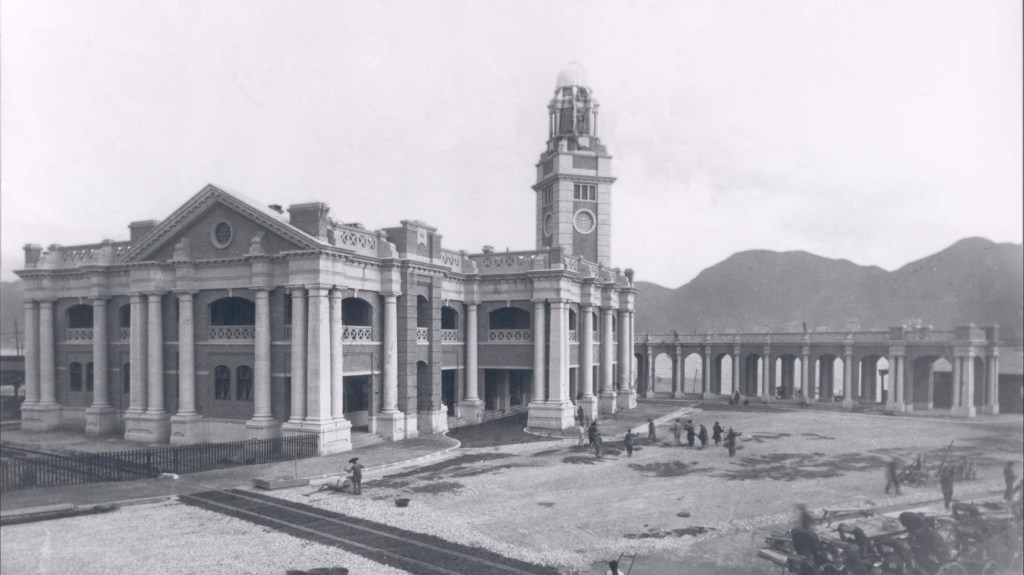
Let’s start with the obvious one first: The Hong Kong Cultural Centre in Tsim Sha Tsui. I already wrote about that thing in a previous article, but I still can’t wrap my mind around that monstrosity. Even more so considering the prime location it was built on. Probably the most noticeable location in the whole of Kowloon. Want to enjoy a nice cocktail at the Peninsula? Well, focus on your drink and forget about the view. That horror of a building will be there, smack in front of you, ruining the view. Now, to add insult to injury, the building of that horror required the destruction of a magnificent early-twentieth century railway station; the so-called Kowloon Railway Station, completed in 1916 and torn down in 1974.

Still in Tsim Sha Tsui… well, literally across Salisbury Road from the Cultural Centre, in fact, you can visit 1881 Heritage; the former Marine Police Headquarters. This historical building was not demolished. To Hong Kong standards, that’s a win. But what would have been the utmost perfect opportunity for a museum or touristic attraction of some sort… has been turned into a small shopping center hosting a few luxury brands. Ironically, at any time of the day or evening, 1881 Heritage is packed with visitors taking pictures. The shops, however, are always empty. Proof, if needed, that our Hong Kongese geniuses completely miss-evaluated the potential of the building.

1881 Heritage. Tsim Sha Tsui, Kowloon. 14 October 2017. Photo: Gweilo Rant.

This being said, let’s turn to the less obvious missed opportunities. See, from a historical point of view, Hong Kong is a city of astounding importance. Its historical and cultural context, a crossroad between the East and the West, makes it one of the most unique cities in the world. Sorry… I mean, made it one of the most unique cities in the world. Nowadays, history is buried deep, deep under buildings without the least shred of value other than the price of the concrete they are made of and the scarce land they are built on.

Yet, with an observing eye, and basic interest in culture and history, you can still spot a few remains of said history. Think about Boundary Street, between Sham Shui Po and Prince Edward, which literally marked the boundary between British Kowloon and Qing-Dynasty China until the lease of the New Territories in 1898. Or Reclamation Street, stretching from Jordan to Prince Edward, which marked the Western shoreline of Kowloon before land was reclaimed from the sea. Yes, in Hong Kong, you can retrace the history of the city just by walking down the streets. But this is Hong Kong. Does history generate money? No? So, who gives a fuck?

Think about the Kowloon Walled City. This tiny and seemingly insignificant speck of land, located in Kowloon City, is dense with history. Probably denser with history than 99% of Hong Kong. So, what did Hong Kongers do? They demolished it, of course. Now, they didn’t build yet another shopping mall on top of its remains. Another win, to Hong Kong standards. Instead, they built a nice but uninteresting park; the Kowloon Walled City Park. If you want to learn more about the Walled City, they left a few remains. But don’t expect anything of informative value. You’ll need the internet for that. And a lot of imagination.

Let’s stay in the vicinity of Kowloon City for a little longer. And let’s visit Hong Kong’s former airport: Kai Tak. When I first landed in Hong Kong, I was terribly disappointed to land in Shek Lap Kok, nowadays international airport. Mind you, Kai Tak ceased operating as Hong Kong’s international airport in 1998. So, what could Hong Kong have done with one of the most iconic landing strips in the world? On top of my head, they could have turned it into an aviation museum, and display aircrafts on the landing strip, for instance? But not in Hong Kong.

Rather, Hong Kongers… yes, they built yet another bland housing estate on the northeastern side of the airport. How about the landing strip? Well, large parts of it are left to rot, obviously, unused, whilst another part is used as a cruise terminal. The end of the landing strip, on the other hand, has been transformed into a park. It is one of the bleakest and most depressing areas in Hong Kong. Somehow, very few people bother visiting this historical landmark; which adds to the eerie feeling one may experience on that long empty stretch of concrete that was, once, the gateway in and out of Hong Kong; bustling with activity.

Now, I’d like to talk a bit about the landmark that sparked this rant: Tung Chung Fort, on Lantau Island. There is no way I can sugarcoat it; this place is an absolute disgrace. The path leading from the road to the entrance of the fort is bordered with rubble, construction waste, and rusted metal pipes, rods, and wires in all shapes and sizes. In front of the fort, Hong Kongers felt the need to build one of those fucking ugly villages they are so fond of. They could have built it anywhere else but, no, they had to build it, there, right in front of a historical landmark. To top it off, right at the entrance of the fort, they opened a “restaurant” in which attention to hygiene is visibly questionable.

Entrance to Tung Chung Fort. Tung Chung, Lantau Island. 19 April 2020. Photo: Gweilo Rant.

And once you enter the fort you are greeted with… a basketball court. Yes, a basketball court! Now, I love basketball but, for fuck’s sake! You gotta be kidding me. A basketball court inside a historical monument. Well… monument… it was declared a Monument of Hong Kong in 1979. Not exactly treated as such, though. Deeper inside the fort, they even built a sturdy concrete ping-pong table. What else can I say than “what the fuck?”

A basketball court built in the main yard of Tung Chung Fort. Tung Chung, Lantau Island. 19 April 2020.
Photo: Gweilo Rant.

I mean, try to imagine Texans building a baseball diamond inside the Alamo. Or the French building a rugby pitch in the gardens of Versailles. Now, sure, Tung Chung Fort doesn’t have the same historical significance as Versailles or the Alamo. But Hong Kongers didn’t leave too many historical sites standing. The least they could do is take proper care of the few remaining ones.

What Hong Kongers do very well, though, is being dirty. And dirty, it is! In fact, Tung Chung Fort is the perfect example of what Hong Kong would look like if the city wasn’t crisscrossed by armies of underpaid street cleaners day in, day out. Now, they are not just dirty, they are sneaky dirty. See, the main yard is deceptively spotless. But, past the main yard, behind the ridiculously tiny exhibition hall, where not too many visitors venture, the place is littered with trash. Everywhere. Empty take-away boxes, cans, and construction debris. Yes, the fort is used as a giant trash can by the village surrounding it. Normal. This is Hong Kong.

Now, Tung Chung (and its immediate surroundings) is home to a very interesting historical site that tells the pre-colonization story of Hong Kong. But it’s left to rot. Instead, Hong Kong literally built a touristic hotspot from scratch: Big Buddha (also known as Tian Tan Buddha) and Ngong Ping Village. Completed in… 1993. And yet, this is what people come to visit in Tung Chung… Now, Tian Tan Buddha is an important Buddhist center, but Ngong Ping Village was built exclusively for tourists. So much so, in fact, that no one has ever lived in that village.

Before concluding this article, one needs to give Hong Kong some credit, though. I mean, kind of. Have you ever heard of Sam Tung Uk? If so, kudos. If not, don’t worry, it’s absolutely normal. Hong Kong seriously sucks at promoting its own history. Sam Tung Uk is a 200-year old walled village located only five minutes away from Tsuen Wan MTR station. It was declared a historical monument in 1981 and restored. Yes, you read right; instead of building housing estate number ten thousand four hundred sixty four, they actually restored a historical landmark! And, as opposed to Tung Chung Fort, it is very well maintained.

Obviously, this place is always empty; which makes for a very relaxing visit. Now, there are many more places like this in Hong Kong, of course. Well, not that many, in fact. But, as I said, you better know where to look for those because, you know, don’t expect Hong Kong to promote its legacy. Even its pre-British legacy.

I have a few ideas to revitalize those historical sites, though. Perhaps building mega shopping malls on top of those sites would make them more popular destinations? Or, one could install free 5G hotspots inside those historical buildings. With gigantic air-conditioning units to cool down the atmosphere, obviously. Look, you have to adapt to your target audience.

HONG KONG – Keep Your Eyes off Your Phone (and Learn to Walk)

People on the MTR. Can you spot who’s not on his phone (Hint: no one)? Wong Tai Sin, Kowloon. 17 March 2020. Photo: Gweilo Rant.

If you’ve ever walked in Hong Kong -anywhere in Hong Kong- you’ll probably have noticed the mindbogglingly high density of smartphones in the city. They are everywhere. In the streets, on the MTR, in shopping malls,… Everywhere.

As a result, it will come as no surprise that Hong Kong came second, in 2018, in the global ranking of mobile cellular subscriptions per capita with 270 mobile cellular subscriptions per 100 people. Second only to its neighbor Macau.

And that high density of smartphones in a city such as Hong Kong leads to some frustrating issues. See, Hong Kongers are notoriously bad at walking. They are slow as fuuuck, they are unable to walk in straight lines, they walk all over the place (on the right, on the left, and in the middle of the path), they have a tendency to stop smack in the middle of paths on a whim,… 

More generally (and this is a constant in Hong Kong), they have absolutely no spatial awareness what-so-ever. If they need to make a turn, they’ll make a turn, regardless of incoming traffic (preferably cutting people’s way). When they exit a shop, they exit, regardless of incoming traffic (preferably cutting people’s way). The list is endless.

Simply put, they suck at walking. And that’s before we even brought the smartphone into the picture. The walking skills of Hong Kongers may be below par but, put a smartphone in the hands of a Hong Konger and his walking skills… will drop deeper than the Mariana Trench. As incredible as it sounds, this can be witnessed on a daily hourly minutely basis. And just about anywhere in Hong Kong (preferably in congested areas). All you need to do, is get out on the streets of the city. Because, you see, the Hong Konger is enamored with his phone.

With the invention of the smartphone, Hong Kongers, on top of lacking the minutest form of spatial awareness, also lost the awareness of their own physicality. You could stab a Hong Konger, if he’s on his phone, he would realize he was stabbed only after he put his phone back in his pocket.

A little anecdote will help you understand. As I often walk down the overcrowded streets of Hong Kong, I very often bump shoulder-to-shoulder with other pedestrians. Nothing special so far. That’s pretty much a given on the narrow sidewalks of Hong Kong. However, with the advent of the smartphone, people have started meandering more spectacularly than ever before. And, on a few occasion, as taking evasive action is impossible due to the crowd, people with eyes glued on their phone end up smashing into my body, execute a half-spin, regain balance, and keep on going.

In such situation, you’d expect a “sorry” of some sorts. Or, at least, some reaction. Or an acknowledgement from the person that smashed into you that he collided with someone/something. Forget about it. When their eyes are glued to that screen, the world surrounding the Hong Kongers vanishes. They may bump into people, not once would they avert their eyes from their screen. Yes, the average Hong Konger is rude by default, but give him a phone, and he forgets the most elementary principles of life in a civilized society.

Look, in any normal country or city, people look where they are going. The Hong Konger, when busy on his smartphone, doesn’t. Rather, he expects you to avoid colliding with him. Well, I’m slightly exaggerating here. He doesn’t expect anything. He’s simply too absorbed in his insanely-mind-blowing-game to pay the littlest attention to anything around him. Or, in other words, he simply doesn’t give a fuck. Sometimes I wonder if they even realize where they are.

If their lack of focus -and walking skills- wasn’t that infuriating, you could find amusing qualities in their walking posture. Usually, when you see people walking toward you, you’d expect to see eyes, a nose, and a mouth. In Hong Kong, what you tend to see more frequently with each passing year, however, is a ball of hair. Nothing but hair. Well, I have to admit, this is great for taking photos to illustrate articles, as I no longer have to bother blurring faces. This is evolution in progress… some people are more “advanced” than others, as you can see from the photo below.

Two men on the MTR, checking their phone. Kwun Tong, Kowloon. 2 December 2019. Photo: Gweilo Rant.

Now, I know what you are thinking: “He’s ranting about a non-issue, again.” And, granted, it would be a non-issue if those encounters happened once or twice per week on empty sidewalks/paths. I wouldn’t have noticed it -let alone dedicated an article to it- if it only happened once in a blue moon. But the fact is that you’ll run into people handling their phone while walking once or twice… per minute. I wish I was exaggerating, but I am not.

This being said, there is one more point that needs to be covered. So far, we only mentioned people walking while playing on their smartphone. Although impaired in their walking by said device, which slows down the traffic behind them, at least, they are moving. Another breed of smartphone users we need to talk about, however, are the people who stop smack in the middle of the sidewalk every time they receive a message. Keep in mind that we are still trying to make some kind of progress on pathways on which it is very hard to get past slow -let alone immobile- obstacles.

I mean, the sidewalk in Hong Kong is not just busy. No, it is overcrowded. And did I mention it was narrow? I know I keep repeating myself, but you need to bear in mind the context in which all of this happens to fully understand how much of a pain the issue of the smartphone in Hong Kong is.

See, people in other cities/countries in the world walk while using their smartphones as well. But in other cities, the sidewalks are muuuch wider than in Hong Kong. And pretty much always empty. Or, at the very least, not overcrowded. And people know how to walk properly. And they do not walk at the speed of a rheumatic snail! And when they need to stop, they get on the side of the sidewalk instead of stopping smack in front of you.

Speaking of stopping smack in the middle of the sidewalk, there is a funny experiment you can try to understand how little of a fuck Hong Kongers give about their surroundings. When someone stops in front of you to check their messages, don’t walk around them. Instead, stop right in front of them and stare at them until they move out of the way. Kudos if you get the faintest of reactions. But here’s a little tip, though, if you want to increase your chances of getting a reaction: try this experiment in the Westernized areas of Hong Kong. If you try it in Kowloon or in the New Territories, all you’ll get is a blank stare. At best.

Now, there is one venue in which (some) Hong Kongers become extremely aware of their surroundings, though: the MTR. Especially when they score a seat. In such situation, not only is the smartphone an extension of the Hong Konger’s very self, as it always is, it also becomes an essential and strategic tool. See, in Hong Kong -as in many other cities- the general rule dictates that you give your seat to anyone in need. Well, next time you see a person in need boarding a train… observe the interaction.

On rare occasions, someone will indeed offer his seat. Usually, though, the moment they spot a person in need, sitting MTR travelers will bury their faces very deep in their screen, and pretend they didn’t notice said person in need. I sometimes wonder if they believe they fool anyone when they use such rude and base tactics.

The situations I have depicted so far are frustrating, infuriating, and rude. But the emergence of the smartphone, in Hong Kong, has led to one very sad reality. When you go to the restaurant, or to a coffee shop, it has become increasingly normal to see friends or couples eating in silence as all of the participants are immersed in their games and/or shows. So much so, that one ends up wondering why they went to the restaurant in the first place.

Three friends/colleagues on their phones at Starbucks. Ngau Tau Kok, Kowloon. 5 December 2019. Photo: Gweilo Rant.

Welcome to 21st century Hong Kong.

HONG KONG – Why so (F)ugly?

New Lucky House. Jordan, Kowloon. 26 February 2020. Photo: Gweilo Rant.

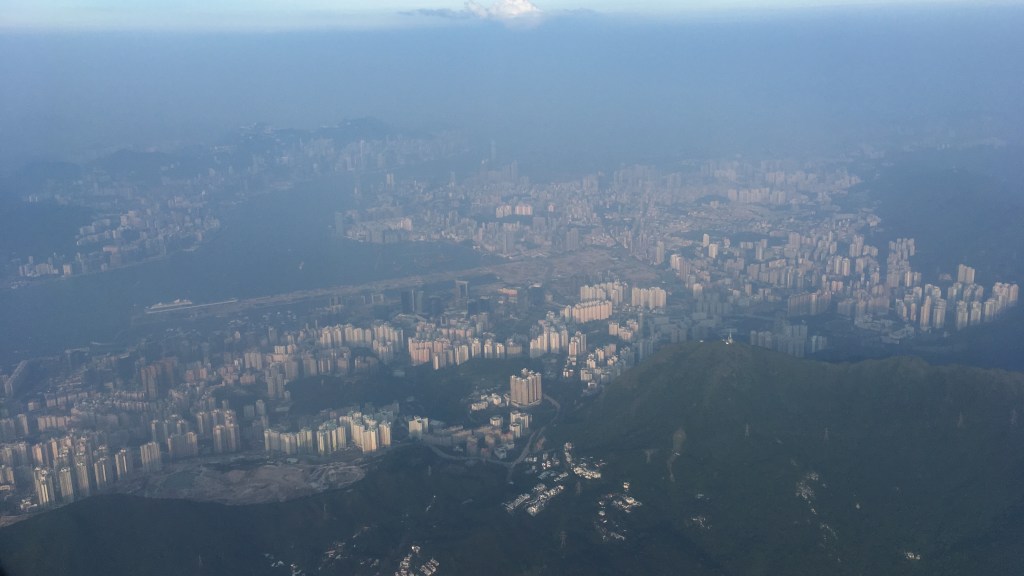
When you travel to Hong Kong, your first impression of the city is one of sheer awe and fascination. As the airplane circles over the city, aligning with the landing strip, you are left to admire nothing but the South China Sea, mountains, rivers, and skyscrapers. A lot of skyscrapers. Nothing but… skyscrapers.

Hong Kong seen from the sky. 14 August 2019. Photo: Gweilo Rant.

No other city in the world offers such a view. Of course, New York City is famous for its skyscrapers. But leave Lower Manhattan, and buildings quickly reach a much more reasonable size. Los Angeles is known for stretching for miles on end in every direction. But leave downtown LA, and you’ll only see two or three-story-high buildings.

You will not see anything of the sort in Hong Kong. What you will see, in Hong Kong, are rows upon rows of gigantic, tightly-packed-together buildings. Industrial, Commercial and Residential alike.

This unique mix of skyscrapers and… well, more skyscrapers, has given Hong Kong Island one of the most iconic skylines in the world: Bank of China Tower, HSBC Tower, Two International Finance Centre (better known as 2IFC or simply IFC), the Hong Kong Convention and Exhibition Centre (HKCEC). All of those buildings are surrounded by other colossal -yet less spectacular- towers.

Alas, none of those buildings were designed by Hong Kongers. One might, of course, argue that Ieoh Ming Pei, the designer of the Bank of China Tower, was partly raised in Hong Kong. But the fact is that he was born in Guangzhou, in the -then- Republic of China (not to be confused with the People’s Republic of China). And he studied architecture at the University of Pennsylvania, the Massachusetts Institute of Technology (MIT), and Harvard University. All of which are located in… the United States of America. As a matter of fact, I.M. Pei died an American citizen, in 2019, and didn’t hold a Chinese passport of any sort.

It would be unfair and untrue, however, to claim that Hong Kongese architects haven’t played any role in the shaping of the skyline of Hong Kong Island. For better or -usually- worse. In that regard, two buildings make a defining impact on the skyline of Hong Kong: Central Plaza (by Dennis Lau and Ng Chun Man Architects and Engineers), located in Wan Chai, with its vulgarly gilded window-panels; and the horrendous People’s Liberation Army Forces Building (designed by Pun How Wai), located in Admiralty.

Central Plaza (Left) and the People’s Liberation Army Forces Building (Right). Hong Kong Island. Source: Internet.

On the Kowloon side of Hong Kong, on the other hand, only two buildings really stand out from an architectural point of view: The International Commerce Center (or ICC), and the Hong Kong Cultural Centre. One was designed by an American architecture firm (KPF); the other one, brainchild of the Architectural Services Department of Hong Kong, has been defacing the Kowloon side of Victoria Harbour since 1989. I’ll let you find out which firm was responsible for the monstrosity in Tsim Sha Tsui.

In the meantime, let’s talk some more about said monstrosity. And yes, obviously, as you guessed, that building was designed by the Architectural Services Department of Hong Kong. To add insult to injury, the construction of this unsightly piece of concrete garbage required the demolition of an architectural jewel: the Kowloon Railway Station. To give you an idea of the style of the building that was lost, look no further than the Clock Tower in Tsim Sha Tsui, its only present-day remnant. And compare it with the building that now stands behind it. To think that the mesmerizingly appalling Hong Kong Cultural Centre was designed to host some of the most beautiful pieces of art is quite ironic.

Kowloon Railway Station (Clock Tower in the background). Tsim Sha Tsu, Kowloon. 1914. Photo: Hong Kong Library MMIS.
The Hong Kong Cultural Centre (Clock Tower on the foreground). Tsim Sha Tsui, Kowloon. Source: South China Morning Post.

Talking about the Kowloon skyline, one must mention two more buildings that stand out due to their sheer size and location: the Victoria Dockside and the Masterpiece. The design of the first mentioned building was led by American architecture firms KPF and James Corner Field Operation. Neither exceptional nor an eye-sore, it just stands there, unavoidable and uninteresting on Kowloon’s shoreline.

The inaptly named Masterpiece (the name itself is quite an exercise in vanity and vulgarity), however, was designed by Dennis Lau and Ng Chun Man Architects and Engineers. Similarly to the Victoria Dockside, it bears no striking features, and just stands there, in all its tall and insignificant -lack of- glory.

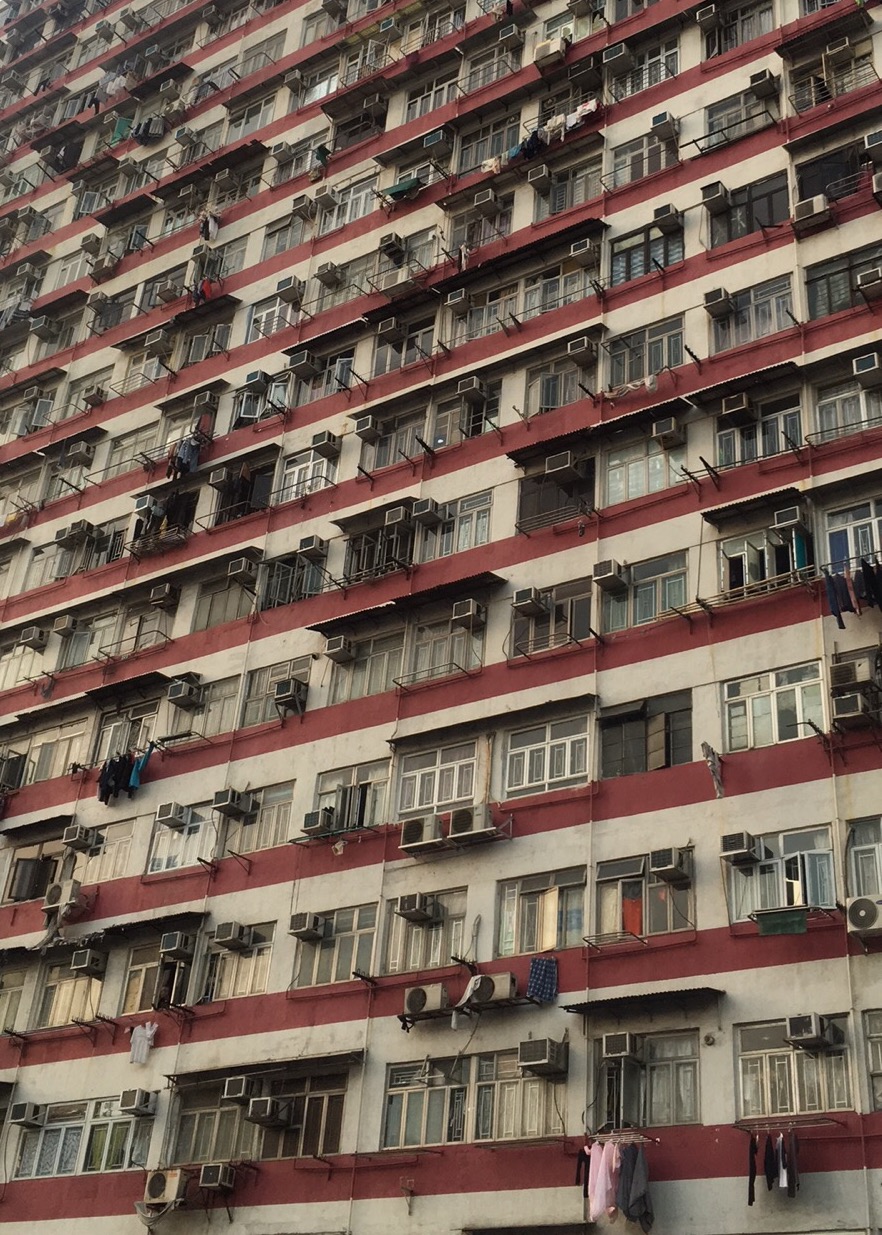
All those buildings -beautiful and ugly alike- only represent a minuscule fraction of the real-estate in Hong Kong. But, compared to residential buildings, one must salute the creative effort put in those buildings. Yes, even in the Cultural Centre. Now, focusing on the residential estate, Hong Kong truly deserves its title of concrete jungle as the vast majority of buildings in the city are little more than that: concrete cubes pierced with windows.

Architects and engineers don’t even bother to hide pipes, which are placed on the outside of the buildings for everyone to enjoy. And if that was not enough, owners and tenants add the final touch to this horror by sticking air-conditioning units directly onto the windows. Better still, on modern buildings architects design ledges specifically for that purpose. Practical? Definitely. Beautiful? I’ll let you be the judge of that.

Building dotted with air-conditioning units. Yau Ma Tei, Kowloon. 26 February 2020. Photo: Gweilo Rant.

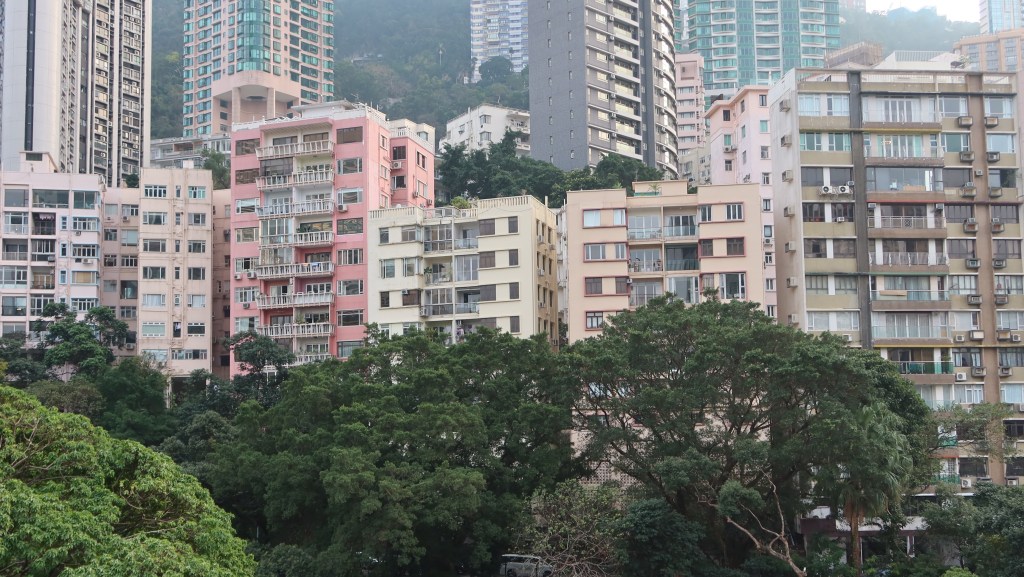
Now, one might think that this is only the case in the poorer districts of Hong Kong, such as Sham Shui Po or Kwun Tong. After all, aren’t all poorer areas in the world uglier than the wealthy ones? Well, yes, it is true to some extent. But not in Hong Kong. Whether you go for a walk in Kwai Tsing (third poorest district in Hong Kong) or in Mid-Levels (one of the poshest neighborhoods), the buildings are equally ugly. Bear in mind that we are solely talking about architectural ugliness, here. Rich areas remain (much) cleaner and less chaotic (kinda) than poorer ones. But the fact remains that, rich or poor, Hong Kongers simply have no clue on how to design beautiful buildings.

Buildings on Times Square. Causeway Bay, Hong Kong Island. 2 February 2020. Photo: Gweilo Rant.
Buildings on Kennedy Road seen from the Fighting SARS Memorial. Mid-Levels, Hong Kong Island. 15 February 2020. Photo: Gweilo Rant.

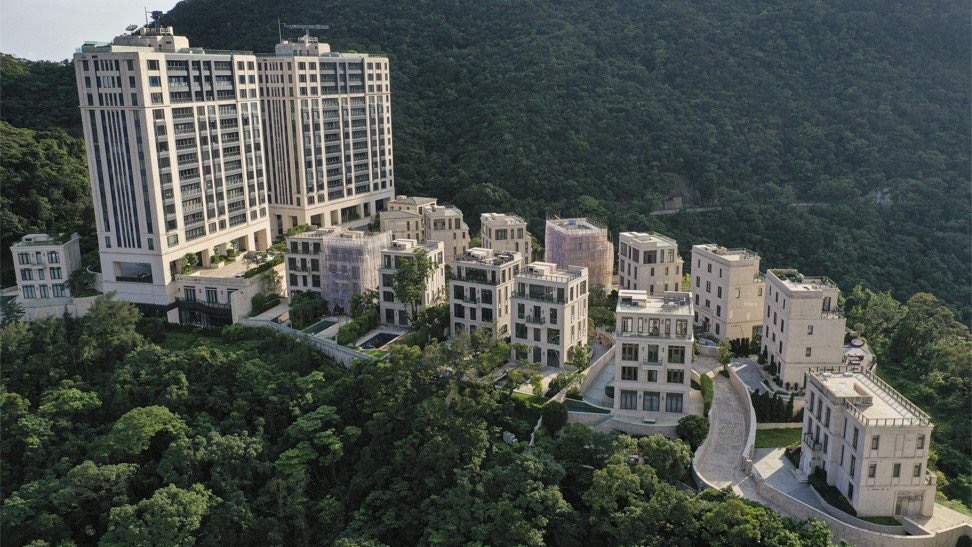
Even the wealthiest area in the city, namely The Peak, isn’t impervious to the ambient blandness of the city. Extremely wealthy Hong Kongers do not hesitate to splash in excess of a billion dollars (HKD) on real-estate on the Peak. And what do they get for that price? Well, remember the concrete cubes pierced with windows I mentioned earlier? That’s what they get. Only bigger. And on premium land.

Sure, beauty is in the eye of the beholder, but give a look at the $1.25 billion HKD houses in the photograph below. They’re all the same featureless cubes! I mean, seriously, wasn’t there enough money, in those $1.25 billion HKD, to hire an architect to design houses with more architectural gusto and/or personality? Oh, wait… It was designed to appeal to the wealthy? Well… like I said… beauty is in the eye of the beholder, isn’t it?

Luxury estate on Mount Nicholson. The Peak, Hong Kong Island. Photo: Martin Chan (through South China Morning Post).

This shows the general state of mind prevalent in the city. See, Hong Kongers think primarily in terms of money. Creativity and imagination didn’t just take a backseat in Hong Kong; they were left behind on the sidewalk to be trampled by the masses. Think of it, the most common New Year’s greeting in Cantonese (恭喜發財; kung hey fat choy) literally means “Congratulations for becoming rich”. It doesn’t get any more explicit than this. Now, think a bit further. Will a beautiful building generate more money than an ugly one? No. In this case, who gives a fuck about designing a nice-looking building?

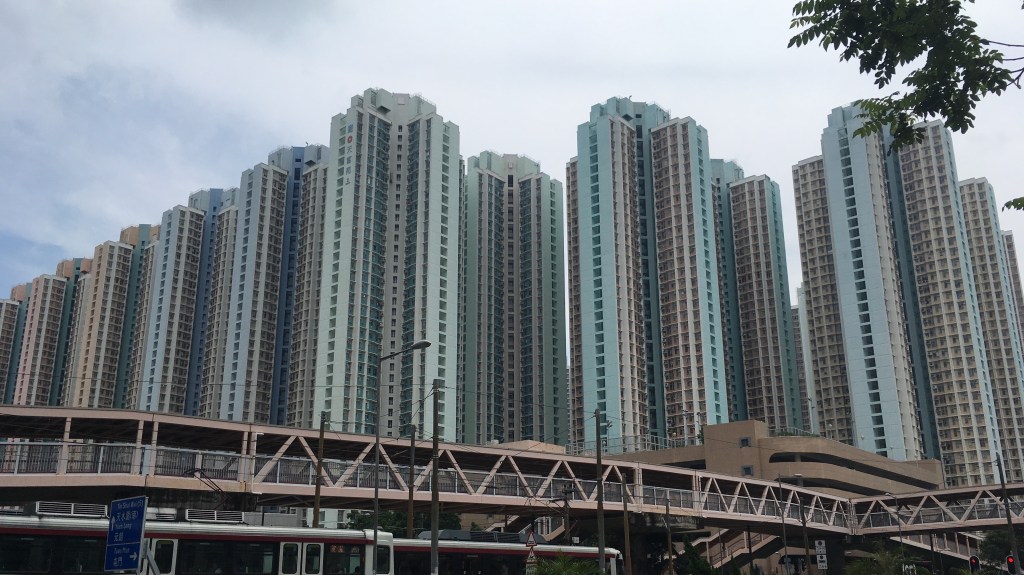
This transpires best in the public housing sector. Whether you are in Tung Chung (West of Hong Kong) or in Chai Wan (East of Hong Kong), all public housing estates are based on the same blueprint. This enables contractors to pre-fabricate entire storys and pile them up one on top of the other, like Lego. And in less than a year an entirely new neighborhood has sprung out of the dirt, identical to all other public-housing neighborhoods in Hong Kong.

Identical buildings in a public housing estate. Tin Shui Wai, New Territories. 30 September 2017. Photo: Gweilo Rant.

In this regard, Hong Kongers are extremely efficient. But then again, building crap has always been quick. Especially when you’re merely copy/pasting ad nauseam. This way of building has turned Hong Kong into a bland and boring city to look at. And it seems Hong Kongers haven’t understood yet that living in a nice environment improves your quality of life. But this being Hong Kong, who gives a fuck?

HONG KONG – Are You Really Going to Put That in Your Mouth?

Man hacking a fish. Sham Shui Po, Kowloon. 2 February 2020. Photo: Gweilo Rant.

And no, I’m not talking about chicken feet. Neither am I talking about pigs’ intestines. Nor about the infamous stinky tofu. As a matter of fact, once you’ve wrapped your mind around it, all of those food items reveal… edible. Besides, every country/society has its own weird food, isn’t it?

Think about the French pieds de porc (pigs’ feet) or escargots (snails), for instance. Better, in Italy, the Sardinian casu marzu (rotten cheese) is known for containing maggots. In its Corsican variant, casgiu merzu, however, the same cheese is served with the maggots… still alive. In Japan, fugu (pufferfish) could -literally- kill you if prepared improperly. In the United States, you can buy spray cheese… Think about it, cheese in a can! If you drink kopi luwak in Indonesia, you are drinking coffee made of half-digested coffee cherries. Yes, you are literally drinking civet droppings.

All in all, reflecting on some of the dishes served in other countries in the world, including in the West, you’ll come to the conclusion that eating chicken feet is not that weird, after all. And that’s a good thing, because, I’m not going to talk about what is eaten in Hong Kong. No, I’d like to address the issue of how food is displayed in Hong Kong.

See, Hong Kongers entertain a schizophrenic relationship with hygiene. On the one hand, they are quick to jump to their hand sanitiser for no reason, which is a good thing in times of epidemics. On the other hand, however, they’ll also handle their phones in the washroom and… leave said washroom without washing their hands. Did you say paradoxical?

Furthermore, if you dare to undertake an adventure outside of the heavily Westernized parts of the city after the armies of underpaid street cleaners have disappeared from sight (they need to rest too, you know), get ready to put your slalom skills to the test whilst avoiding trash scattered all over the sidewalks.

Now, since we’re in the streets of Hong Kong, how about we give a look at those shops selling “fresh” food? And, again, obviously, forget the Western-style shops of SoHo and Mid-Levels. Those places know their Western(ized) clientele and their high demands regarding food quality -hence, hygiene.

No. Today, we will go… local. If you’re not used to leaving the Western part of Hong Kong Island, get ready for a wild ride. Hopefully you’re not too squeamish with food because… well, you’ll see why in a second.

Let’s start with the butchers, because I like a nice steak… but not in Hong Kong. Meat in Hong Kong is downright scary. See, in Hong Kong, the meat that you are going to eat is often carved on the sidewalk. And I mean that in the most literal sense of the term: on the sidewalk. Come Winter, come Summer. Of course, you won’t believe me (unless you’ve lived in Hong Kong for some time already). So, just look at the photograph below of a random butcher in Hong Kong.

Butcher carving meat in Hong Kong. Sham Shui Po, Kowloon. 2 February 2020. Photo: Gweilo Rant.

Yes, that’s the sidewalk she is standing on as she is carving pieces of meat to put on display… on a wooden table. And the other pieces of meat? Well, they are dangling from hooks above that wooden table, of course! Funny story, this butcher is remarkably clean (there is no blood splatter on the walls) compared to other butchers in Hong Kong.

I beg your pardon? Ice? You’re looking for ice? Or a cooling system? A refrigerator? What are you talking about? This is Hong Kong! No need for a cooling system. Look, it’s not like temperatures commonly soared past the 30 degrees centigrade mark. Oh, wait, it does… every day in Summertime. Oh, well… I told you to get ready for a wild ride, didn’t I?

This reminds me of the story of that restaurant owner in Toronto, Canada who specializes in venison. As vegans protested in front of his restaurant, on 27 March 2018, he decided to carve a deer leg on a table, in the dining room. The police was called, and he got in trouble… for not carving the meat in the kitchen. Now, this is Toronto we’re talking about. In Canada. The day he pulled off that stunt, temperatures ranged between 3 and 7 degrees centigrade. And he got in trouble. Now try to imagine the face of an inspector of the Canadian Food Inspection Agency (CFIA) if he came across a butcher in Hong Kong… in Summertime!

But who care about the CFIA? We’re talking about Hong Kong in this article. And what does the law say in Hong Kong? Well, the Food and Environmental Hygiene Department (FEHD) of Hong Kong says that potentially hazardous food –i.e. raw meat among other- should be displayed “at 4oC or below, or at 60oC or above”[1]. I doubt the meat in the picture above was displayed at 4oC or below, or at 60oC or above… Anyway, I’ll let you read the rest of what FEHD has to say about displaying food items. Looks like Hong Kong fails to enforce its own laws regarding food safety. Just as so many other laws. How come I’m not surprised?

Now, looking at that picture you might say: “This happens in Sham Shui Po, the crappiest poorest district in Hong Kong!” And you’d be right. So, let’s hop on the MTR and cross Victoria Harbour. And on Hong Kong Island, we’re going to see how seafood is handled.

Crap! It’s handled just the same way as it is in Sham Shui Po. However, in the case of fish, some of it is sold alive. But the fish and other crustaceans sold alive are crammed in boxes filled with water that are displayed… Oh no, not on the sidewalk! Come on, be serious. They only do that in Sham Shui Po, don’t they?

No, in North Point, fish is displayed… directly on the road! Yes, on the fucking road! Only a few meters/feet away from the tram tracks! And, again, you won’t believe me, will you? So, why don’t you give a look at the picture below? Still don’t believe me this happens on Hong Kong Island? In such case, why don’t you go and give a look on Java Road for yourself? It is very… frightening.

Seafood shop on Java Road. North Point, Hong Kong Island. 17 September 2019. Photo: Gweilo Rant.

Oh and, I forgot to mention, don’t mind the dead fish or crabs floating beside the item you’re about to buy, of course. In Hong Kong, that’s not a sign of anything bad going on in that water. I mean, fish meant to be sold dying in water is normal, isn’t it? Is water even their natural habitat in the first place?

Moreover, you’ll probably have noticed the professional display in the photo above: styrofoam boxes on top of cardboard boxes. I mean… seriously? That photo was taken in Hong Kong; one of the territories with the highest GDP per capita in the world according to both CIA and the World Bank.

If that was not enough, that particular photo was taken in Summertime. The temperature that day? Between 27 and 32 degrees centigrade. And if you look carefully at the display, you’ll further notice that dead fish (killed on purpose this time) is displayed directly on a metal tray. Metal, Summer, dead fish. So what? Metal is not a good heat conductor, is it? Oh, wait, it is. Anyway, Summertime is not that hot in Hong Kong, is it? Oh, wait, it is. Oh, well, never mind. After all, what could go wrong with fish lying on the road and in the heat of Hong Kong?

Now, out of curiosity, what does the US Food and Drug Administration (FDA; USA) have to say about fish displays? “Only buy fish that is refrigerated or displayed on a thick bed of fresh ice (preferably in a case or under some type of cover).”[2] Globally, on the other hand, the Food and Agriculture Organisation of the United Nations (FAO) indicates that “(t)he easiest and most effective way to achieve temperatures within the range of from 0 °C to +2 °C (acceptable range) is the liberal use of ice. Where used correctly, ice can rapidly reduce the temperature of fish.”[3]

Interestingly, the United Nations published a Training Manual on Improved Fish Handling and Preservation Techniques, funded by the European Union and geared toward the fishing industry in South Sudan (220th out of 229 countries/territories in the ranking of GDP per capita according to CIA). In this manual, the United Nations recommended fish markets to “display their fish products on clean tables”[4] and “avoid to sale fresh fish in a room temperature without ice”[5].

Granted, there is a loophole in those recommendations. Fish should be displayed on clean tables. The vendor in the photograph above doesn’t display his fish on tables. And when it comes to avoiding fish being sold at room temperature, well, the fish is not sold in a room. So… in your face, United Nations!

Joking aside, Hong Kongese fish markets fail to even meet the recommendations made by the UN to fishers in one of the poorest countries in the world. But then again, what do those American and European Gweilos, or that global organisation understand about food hygiene? They never had to deal with SARS. And Covid-19 didn’t originate in the West. Hold on a second…

Perhaps that’s precisely the reason why Hong Kong should implement -and enforce- the American and European food safety standards. I mean, could there be a link between basic hygiene and those two deadly epidemics that both originated from Chinese wet markets – which are not too dissimilar to Hong Kongese wet markets (wild animals aside)?

See, Hong Kongers are rather inconsequent when it comes to hygiene. They’re quick to jump to their hand sanitiser gel, yet they are not too demanding when it comes to the very food they put in their mouths. The mind-blowing and rather infuriating part, here, is that Hong Kongers were at the frontline of the 2002-2003 SARS epidemic which killed a total of 774 people, nearly 25% of whom in this very city alone. And they still sell their food (mainly meat, fish, and vegetables/fruit) in hygienically questionable shops.

I was told Hong Kongers had been traumatised by the epidemic of 2002-2003. And from their erratic behavior during the Covid-19 epidemic, it seems epidemics truly frighten Hong Kongers. And understandably so. But considering the lack of food-hygiene in their wet markets, and other shops, nearly twenty years after the SARS epidemic, it seems Hong Kongers haven’t learnt from past mistakes; or from mistakes made in China. And that is rather surprising for people boasting the third highest IQ in the world.

Speaking of wet markets… I didn’t mention those yet. And, well, let’s say that regular butchers and fish markets are the epitome of hygiene compared to wet markets. And I didn’t mention hygiene in the (local) restaurants either. There is so much to say about -the absence of- food hygiene in Hong Kong.


[1] https://www.fehd.gov.hk/english/publications/code/allc_4.html. Last retrievd on 16 February 2020.

[2] https://www.fda.gov/food/buy-store-serve-safe-food/selecting-and-serving-fresh-and-frozen-seafood-safely. Last retrieved on 16 February 2020.

[3] http://www.fao.org/3/a-i3221b.pdf. Last retrieved on 16 February 2020.

[4] Training Manual on Improved Fish Handling and Preservation Techniques. UNIDO. Funded by the European Union. p.47.

[5] Ibid.

HONG KONG – Trash and the City

Trash discarded on the street. Sham Shui Po, Kowloon, 24 January 2020. Photo: Gweilo Rant.

If you live in Mid-Levels, or any of the other heavily Westernized constituencies of Hong Kong (i.e. the Western half of Hong Kong Island primarily), you will probably not recognise the Hong Kong I’m about to depict in this article.

When I first visited Hong Kong as a tourist, in 2009, I was mesmerised by the cleanliness of the city. Mind you, as the typical tourist, I only visited the tourist attractions of the city which, obviously, were spotless. This cleanliness, I later realised, was mere illusion.

On a few occasions since I moved to Hong Kong, I have visited Lan Kwai Fong (twice by night and once by day), which is probably the least Hong Kongese area in the whole of Hong Kong. And what a horroshow that place is.

As you might expect from a place that is mainly frequented by Western party-goers, it is filthy. Oh, not by day, of course. By day, it is a pretty dead and quiet street (by Hong Kongese standards). But at night, Lan Kwai Fong comes to life. However, we’re not talking about Hong Kongese nightlife, here. No, we’re talking about Western nightlife -but set in Hong Kong. And, for some reason, Western party-goers all around the world behave like swines. And they’re no different in Lan Kwai Fong

Don’t believe me? Shocked by my words? Next time you visit Lan Kwai Fong, give a quick look at the road before you leave. By midnight, already, it will be carpeted with empty bottles and cans of beer, plastic wrappings of all sorts, and all the trash you can think of. Now, try to imagine what the street looks like at 3AM, after hours of Western-style drinking and partying.

But don’t worry, as soon as the last party-goers will have left, armies of street cleaners paid minimum wage will replace our expats in Lan Kwai Fong. Neither to drink, nor to party. Of course not; one drink in Lan Kwai Fong costs the equivalent of three hours of work for our street cleaners (food for thoughts, here). No, they will, as their job title indicates, clean up the mess left behind by our Gweilos.

Now, that’s Lan Kwai Fong. One street. Frequented by Gweilo party-goers. And, believe me or not, but Lan Kwai Fong is an excellent example of what the rest of Hong Kong -areas inhabited by Gweilos excepted- looks like. The only difference being that, in the other parts of the city, the mess is not created by party-goers, but by normal people engaging in their daily activities.

Trash piled up at the entrance of an MTR station. Sham Shui Po, Kowloon. 29 January 2020. Photo: Gweilo Rant.

You’ll probably think that I’m exaggerating. You probably won’t recall seeing dirty streets in Hong Kong. And I would most definitely trust your honesty. You have never seen dirty streets in Mid-Levels, Kennedy Town, or Sai Ying Pun. As a matter of fact, I myself have never seen a dirty street in any of those areas.

Now, remember the example of Lan Kwai Fong? It is spotless by day. Well, so are all the streets of Hong Kong. And for no other reason that armies of street cleaners criss-cross Hong Kong, relentlessly sweeping the streets of the city. Day in, day out. Seven days per week. 365 days per year (yes, even on Sundays and public holidays).

Street cleaner. Wong Tai Sin, Kowloon. 24 October 2019. Photo: Gweilo Rant.

On top of that, you will often see the poorest of the poor -generally elderly people- push heavy carts through the streets of the city, in an effort to collect whatever recyclable cardboard they can lay their hands on. In exchange, they will be paid a whopping $0.40HKD to $0.80HKD per kilogram (depending on the price of cardboard on the market). Others scour the trash bins, looking for empty cans, and other recyclable trash. A far-cry from our big, semi-automated garbage trucks in the West.

Woman selling waste to Hing Lee Recycle Shop. Quarry Bay, Hong Kong Island. Photo: Xiaomei Chen (through South China Morning Post).

But what happens once their shift is over and they go home? Well, only then do you realise just how dirty Hong Kong really is. Oh, forget about Nathan Road, King’s Road, Hennessy Road, and all the other major streets. Those streets will always be immaculate, for obvious reasons (the image of Hong Kong). Rather, visit the side streets of the city. You won’t believe your eyes.

“But,” you’d ask, “how come I don’t see any of this filth when I go to work at 9AM?” Well, simply because those badly paid street cleaners start their first shift before you wake up. And they waste tons of water -in the most literal sense of the term- every day to clean the streets of Hong Kong before office workers, expats, visitors, and tourists wake up.

And when the expats, visitors, and tourists wake up, they are greeted with the most pristine streets they have ever seen. So pristine, in fact, that it puts their hometowns to shame. Little do they know, however, that this is only possible thanks to the back-breaking labor of thousands of extremely badly paid street cleaners.

This being said, I didn’t talk about Sundays, yet. Look, everything you read so far happens on a daily basis in Hong Kong, but with some (a lot of) goodwill, you can overlook the sorry state the streets are in, generally speaking. In most areas of the city, the amount of trash generated between Mondays and Saturdays remains ignorable. Kinda. Sundays, however, are a whole different story.

On any give Sunday, the entire city turns into one giant landfill. So much so that even the Gweilos living on the -usually preserved- Western side of Hong Kong Island cannot escape the monstrosity Hong Kong turns into. Unless they lock themselves up in their homes, that is.

See, in Hong Kong, many people work five and a half to six days per week. As a result, Sunday is the day when all Hong Kongers -except those working in retail- get a day off. Now, apartments in Hong Kong are not spacious; that is a massive understatement. As a consequence, everybody ends up in the streets and in shopping malls. And they consume. Which generates trash. And ends up in trashcans.

Except that our geniuses in the government decided, in 2016, that the overproduction of trash must be combatted by replacing the existing litter bins with new litter bins… with smaller openings. Which resulted in… less trash! Just kidding, obviously. In fact, more trash has been generated in Hong Kong, in 2017 and 2018, than ever before[1].

Per Capita Disposal Rates of Municipal Solid Waste, Domestic Waste, and Commercial & Industrial Waste in 2009-2018 in Hong Kong. Source: Environmental Protection Department.

Only now, instead of being thrown in the litter bins, thrash that is too big to fit through the opening is thrown on top or beside the litter bins. Seriously, what do they use their third highest IQ in the world for?

Trash thrown beside a litter bin as it didn’t fit through the opening in front of Shatin Government Offices. Shatin, New Territories. 9 February 2020. Photo: Gweilo Rant.

Yet, on Sunday, that is not even the main issue. See, on top of the Gweilos and Hong Kongers, domestic helpers are also generously granted a day off. On the very same day -nearly- everyone else in the city has a day off. This means 350,000 domestic helpers who have nowhere else to go than on the streets and in parks.

And, on any given Sunday night, the sidewalks and parks of Hong Kong turn into an utter disgrace, unworthy of a twenty-first century first-world city. Walk around Central on a Sunday evening, it’s just abysmal. Discarded cardboard and trash of all sorts litter the financial heart of the third most important financial center in the world.

But, again, all night long, thousands of street cleaners put their backs into the cleaning of the city’s streets. And every Monday morning our expat bankers and tourists will stroll around the city on spotless sidewalks.

Ah, Hong Kong. Such a clean city.


[1] https://www.wastereduction.gov.hk/sites/default/files/msw2018.pdf. Last retrieved on 10 February 2020.

HONG KONG – A Schizophrenic Relationship with Hygiene

Hand sanitiser dispenser in Times Square. Causeway Bay, Hong Kong Island. 2 February 2020. Photo: Gweilo Rant.

If ever you come across a Hong Kongese child playing in the dirt, put everything you’re doing aside, and watch. Simply watch. Are you going to be late at work? Don’t worry, it’s just a matter of seconds before the show starts. You’re about to witness a thing of beauty: a Hong Kongese parent going ballistic.

Forget about Operation Jericho. Forget about Operation Thunderbolt. This is a Hong Kongese parent. And his child is playing in the dirt. And a Hong Kongese parent whose child is playing in the dirt would put the Navy SEALs to shame. Yes, Hong Kongers are usually slow and inefficient, but when they see their child play in the dirt, they turn into the epitome of efficiency.

In the blink of an eye, the child is carried out of the dirt, as if he had been drowning in the sea, and wet wipes and hand sanitiser fly out of a purse. The child’s hands are then frantically wiped cleaned before hand sanitiser destroys the remaining bacteria the child may have picked up from playing in the dirt.

To a Hong Kongese parent, there is nothing more terrifying than seeing their child play with sticks, leaves, stones, or, God forbid, creepy crawlies. Look, a broken arm can be fixed. A broken skull can be fixed. But dirt covering their child’s hands? Oh, my God! If they could, they’d probably call 999.

Now, if you ever asked yourself why Hong Kongers are such pussies, there’s the answer. Look no further than their parents. Hong Kongese parents are hygiene-freaks. But they don’t understand that this blind cult to hygiene is exactly what prevents their children from building up their immune system. And once they become adults themselves, those children reproduce what their parents have taught them.

If that was not tragic enough, in Hong Kong you’ll often see children walking around with personal air purifiers dangling from their necks. Personal air purifiers! Granted, the air in Hong Kong is not of the best quality, but it’s far from unbreathable. Now try to imagine those children, whose lungs have been used to only breathe “pure” air, in twenty years. Will their lungs be able to cope with the air of Hong Kong on their own? Or will they need those air purifiers for the rest of their lives?

But enough digressing. Let’s get back to the topic at hand. What’s very interesting, with Hong Kongers, is that their hands are -should be- always very clean; which, it must be said, is a very good thing. Everyone in Hong Kong carries his personal bottle of alcohol-based hand sanitiser. Every parent in Hong Kong has wet wipes in his backpack. And in every shopping mall in Hong Kong, you will find hand sanitiser dispensers.

Then, if you’re of the observing type, you’ll probably have noticed some peculiar habits as well. In Hong Kong, you will never see anyone -except for Gweilos- put their backpacks and other belongings on the floor; be it on the MTR, at McDonalds, or at the restaurant. Never! This sometimes leads to displays of incivility. Especially at McDonalds, where people need two seats: one for themselves; and one for their backpack. Now that I think of it, it’s more likely they just don’t give a fuck.

Man sitting with his backpack on the chair next to his at McDonalds. Kwun Tong, Kowloon. 3 February 2020. Photo: Gweilo Rant.

But well, at least, their backpacks stay clean. There’s another object, however, which Hong Kongers cannot live without. To be totally fair, the entire twenty-first-century world is enamoured with that object. Unfortunately, it is also known to be a perfect breeding ground for bacteria of all sorts. And that object is none other than the smartphone.

Now, Hong Kongers love their smartphones. So much so that you’ll frequently see Hong Kongers handling two smartphones. When they are not sleeping, they are glued to that small screen every single minute of their free time. And when I say every single minute, I mean every single minute. This means, when they go to the washroom also. Yes, men too.

And they do their business whilst holding their phone in the hand that is not busy aiming straight. Now, I know what you’re thinking: “you, perv, you’re watching men in the washroom!?” No, I don’t. But as the majority of human beings, I posses peripheral vision. And, unfortunately -in such situations- I can’t switch it off, however much I’d love to.

This being said, if you’ve ever used men’s urinals, you’ll know that splashes are inevitable. Yes, splashes of… you know what. And that means, on the screen of their smartphone as well if they’re using it while doing their business. I’ll just let you imagine what happens when they receive a call afterward.

The troublesome part doesn’t end here, though. Oh, no! Once male Hong Kongers are done using the washroom, they usually rinse their hands. Just a quick rinse. And the soap? What about the soap? It’s nice and cosy in its container. Why? Would you like men to wash their hands with soap after they’ve used the washroom? Well… sorry to say so, ladies, but in Hong Kong, that doesn’t happen often.

If you’re not grossed out by that, how about people clipping their nails on public benches, on the bus or even -why not- on the MTR? Yes, in Hong Kong, that’s not as uncommon a sight as one might hope. But there is better! Since you started clipping your nails, why not go all the way? Take off your shoes. Take off your socks. And… you guessed it, some people feel so comfortable on the MTR they don’t hesitate to clip their toenails on the train. Although less common than people clipping their fingernails, it happens.

That habit may be disgusting, it rarely contaminates people with diseases, though. What’s very disturbing with Hong Kongers and their obsession with hygiene, geared almost entirely on hand hygiene, however, is their lack of knowledge on the topic. Considering the amount of time they spend on their phones, one may think they are doing a lot of research and are well documented on the subject. Well, you’d be right, if checking Facebook, watching videos, and playing video games amounted to doing research.

The epidemic that erupted in Wuhan, Hubei Province in late 2019 and early 2020 has shown that Hong Kongers simply follow the masses without understanding what they are doing. At the peak of the epidemic, everyone In Hong Kong was wearing a surgical mask. The sad truth is that, according to all disease control agencies in the world, surgical masks provide healthy people with extremely limited protection against any form of infection.

Now, let’s assume surgical masks did offer some protection. After the SARS epidemic that hit Hong Kong in 2002-2003, you’d expect Hong Kongers to know how to properly use a mask. Well, you’d be badly surprised. People keep touching their mask, removing their mask, reusing their mask. Children often put their mask in their pockets -ideal breeding ground for bacteria- before putting it back on. There is so much to tell about the face mask and its misuse(s) in Hong Kong (and elsewhere) I should probably dedicate an entire article on the topic.

This being said, we have only scratched the surface regarding hygiene in Hong Kong. To be complete, one should also mention hygiene in restaurants, as well as hygiene in the city altogether. And what a horrorshow that is! But that will be for a next article.

HONG KONG – Missing: Passion. Have You Seen Me?

Lunar New Year decoration in Palace Place. Admiralty, Hong Kong Island. 21 January 2020. Photo: Gweilo Rant.

If you have ever been to New York in December, you will definitely have noticed that, around that time, Christmas is around the corner. The entire city exudes an unmistakable Christmas atmosphere. Shops compete with one another to offer customers and passers-by the most exuberant displays. And the city itself is draped in Christmas ornaments.

Crossing the Atlantic Ocean, you’ll be welcomed with city squares conquered by transitory Christmas villages, where you can taste Winter-themed beverages and food, or buy Christmas goodies in all shapes and sizes. Entire cities are decorated with wreaths, Christmas trees, and tinsels; be it in France, in Germany, in the United Kingdom, in Italy, or in every other European country.

And if, from the subtle hints covering the cities, you still haven’t noticed Christmas was at the doorstep, supermarkets, shopping malls, TV channels and radio stations on both sides of the ocean will remind you 24/7 to get ready for the most important day of the year in the Western tradition.

Now, I’ll spare Hong Kong the affront of comparing Christmas in the West with Christmas in Hong Kong. After all, as I mentioned, Christmas is a Western tradition. And Hong Kong is not a Western city. However, if Christmas is a secondary celebration in Hong Kong, one festival is of the utmost importance in China (including Hong Kong): Lunar New Year. Or, as Westerners call it, Chinese New Year.

And, if you don’t know how important that day is, don’t count on Hong Kong and its citizens to remind you that Lunar New Year is one of the cornerstones of the Chinese tradition. In the weeks leading up to Lunar New Year, the streets of Hong Kong are as bleak as usual, people are zombies as usual, and shops are as bland as usual… In a nutshell, nothing sets Chinese New Year’s Day apart from just about any other day.

As a matter of fact, a foreigner who’d visit Hong Kong around the time of Lunar New Year -or even on Lunar New Year’s Day- wouldn’t realize New Year is coming. Unless someone told him, that is. Oh, sure, he would see the odd lantern dangling here and there. But they’re so few and far between he wouldn’t realize those are actual Lunar New Year decorations. The thing is that, as opposed to the Christmas spirit in the West, there is no Lunar New Year spirit in Hong Kong.

And there is no Mid-Autumn festival spirit either. Nor any Qing Ming or Tuen Ng Festival spirit. In fact, more than a mere lack of spirit, in Hong there is lack of passion surrounding festivals and traditions altogether. Hard to believe, isn’t it? After all, on Lunar New Year, Lion Dances are performed all around the city, blessing restaurants, shops, and businesses of all types.

Well, if you want to have a chance to come across one of those dances, you better know where they will take place. See, Lion Dances -and Dragon Dances- are not a chance occurrence. Lion Dances are not performed out of popular fervor. Lion Dances are not performed because people want to perform those dances. No, in Hong Kong, Lion Dances only take place in front of shops, restaurants, and shopping malls that have paid to be blessed. Yes, in Hong Kong you need to pay if you want to be blessed. No money, no blessing.

In other worlds, sorry, you poor fucks. Get rich, and then you’ll buy yourself some blessing. Sure, you may have been told that money was a blessing in itself… So, to be blessed with money, spend some money to be blessed with money. Hold on a minute. That makes no sense. If I have money, why would I spend that money to earn the money I just spent to make more money… That reminds me of the story of the snake that eats its own tail (in its exoteric meaning). But well, Hong Kong and logic…

Anyway, next time you witness a Lion Dance, don’t look at the “lion” itself. Instead, observe the people who dress up as said lion; observe the people escorting said lion; observe the people playing the traditional music accompanying the Lion Dance. And, more specifically, try to find a hint of emotion on their faces. I can guarantee you won’t find any other than boredom. As if they did it because… well, it’s a job like any other, isn’t it?

Unfortunately, like I said, in Hong Kong, coming across Lion Dances on Lunar New Year is not as easy as one may expect. As such, you won’t be able to put my word to the test. Too bad… BUT! We live in the 21st century and I want you to put my word to the test. So, why don’t you type down “Lion Dance Hong Kong” on Youtube, and watch each and every video available of Lion Dances that were performed in Hong Kong in the past years. And you’ll notice that… dammit, not the least emotion on the performers’ faces. In none of the videos. Zero. Zilch. Nada. Niente.

Now, this lack of passion Hong Kongers put in their festivals and other celebrations also translates in a lack of originality. On several levels. Think about it. What are the decorations for Lunar New Year? Lanterns. What are the decorations for Mid-Autumn Festival? Lanterns. What are the decorations for the celebration of Buddha’s Birthday? Lanterns.

If you have children who attend a local kindergarten, what will the teachers ask them to bring to school for Mid-Autumn Festival? Lanterns. What will the teachers ask them to bring to school for Lunar New Year? Lanterns. In fact, in Hong Kong, whatever the celebration, lanterns will never be out of place.

And that’s not all. Hong Kongers like to eat, like anyone else on this planet. And on Lunar New Year, Mid-Autumn Festival, or any other celebration, you will have dinner with your Hong Kongese family. Now, either you will have dinner at one of your relatives’ home, or you will go to the restaurant. Either way, the menu will be exactly the same: Chinese mushrooms, some seafood, fish balls, chicken and pork. No matter the family. No matter the occasion. No matter whether you go to the restaurant or dine at home.

But, how about the most important day in one’s life: wedding? Well, brace yourself for one mind-blowing display of Hong Kongese originality. No, just kidding. If you have been to one Hong Kongese wedding, you’ve been to all Hong Kongese weddings. Besides the faces and the venue, everything else will be the same from one wedding to the other. All the way to the food you’ll be served at the banquet.

Oh, and, of course, at exactly 10PM everyone leaves! No matter who’s wedding it is. At 10PM, you leave. That’s the -unwritten- rule. And what if you’re not aware of that rule, you silly Gweilo? Or what if your watch is broken and you don’t know it is 10PM? Don’t worry, subtle hints will let you know the party’s over: no more food will be available; don’t expect that one last beer; half the guests will be gone by 10:05PM; and large round planks made of wood -the table tops- will start rolling across the banquet hall.

Now, since we’re on the topic of weddings and Lunar New Year, how about we talk about gifts. And, what a sad state of affairs this is. In Hong Kong, gifts must remain as impersonal as possible. As such, when you are invited to a wedding, do not buy any gift to the married couple. Instead, you will give them an envelope with money: the famous Lai Si (紅包; red packet).

And, if giving money to a married couple wasn’t sad enough in itself, don’t give them just any amount. No, no, no, no, no. In Hong Kong, there are charts that will indicate how much you should give a married couple, depending on your closeness with the couple, the venue in which the banquet takes place, and other variables. However sad this is, I am not kidding one bit. Charts to tell you how much you should give a married couple. Way to be spontaneous! Of course, you could give more than the amount indicated on the chart, but that would be a very un-Hong Kongese thing to do.

On Lunar New Year, the tradition of Lai Si is yet another sad endeavor. Traditionally, Lai Si was not exactly a gift, but a protection against evil spirits. However, as time passed, the meaning of Lai Si evolved. So much so that, today, the alternative name for Lai Si, 利事, literally means “good for business”. Obviously, what did you expect? Everything in Hong Kong revolves around money and business.

And, as with the Lion Dance, Lai Si is not something one does from the bottom of their heart. No, it is done because, well, it has to be done. The moment someone enters the venue where family, friends, or colleagues have gathered, they will quickly and without much fanfare give out their red packets to whomever should receive a red packet, then exchange a quick Sun Lin Fai Lok (新年快樂; Happy New Year), Kung Hei Fat Choy (恭喜發財; Be prosperous and happy), Sun Tai Geen Hong (身體健康; Wish you good health), or any other well codified blessing (don’t try to be original in such circumstances). The Lai Si will then quickly disappear in the recipient’s pocket or purse, and that will be it. Over and done with the Lai Si until the following year.

In fact, in Hong Kong, if you want to see actual gifts being exchanged –i.e. gifts that will have been chosen carefully and specifically for you, gifts that show how much someone cares about you and knows you, gifts someone will have put thought into- then you’re going to have to wait for the Western celebrations to come around. That is, Christmas or Valentine’s Day, for instance.

Now, perhaps I have been a bit harsh with the lack of passion displayed by Hong Kongers in their festivals and celebrations. Truth be told, every year, in Hong Kong, there is one event Hong Kongers and foreigners alike are passionate about. Well, foreigners more than Hong Kongers, to be honest. Although, Westernized Hong Kongers are pretty fond of that event as well. And that event, drawing visitors from all around the -mainly Western- world, is none other than the Hong Kong Sevens. But is rugby really a Hong Kongese tradition? Or was that tradition imported by the British founders builders colonisers of the city?

HONG KONG – Mini Flat for Maxi Price

Residential Estate in Ap Lei Chau, Aberdeen Island. 26 August 2017. Photo: Gweilo Rant.

Apartments in Hong Kong are not spacious. That’s a euphemism. In fact, they are tiny. Horrifyingly minuscule. And I’m not talking about the infamous cages stacked in even tinier rooms. No, I’m talking about the average apartment you will find in Hong Kong. At a whopping 484 sq ft, said apartment is -surprise, surprise- the smallest in the world.

Just for the sake of comparison, in the United States, apartments and/or houses average 2,164 sq ft. And those are not even the largest in the world. That title would go to the Australian apartment which boasts an impressive 2,303 sq ft on average.

Now, comparing Hong Kong with countries the size of the United States or Australia makes little sense. Let’s rather compare the housing situation in Hong Kong with the situation in a more comparable city/country. It so happens that such a city exists and is indeed often compared to Hong Kong. That city is none other than Singapore. With a population 24.2% smaller and a total land area 34.8% smaller than Hong Kong, Singapore is the perfect city to compare Hong Kong with. And the comparison is not exactly flattering.

Notwithstanding a similar context of over-crowdedness, Singapore’s average apartment reaches a respectable 1,022.5 sq ft. That is, more than twice the size of the average apartment in Hong Kong. In fact, considering the size of average households in both cities -3.24 people per household in Singapore versus 2.8 people per household in Hong Kong- this means that in Singapore each person has a personal living area equal to 290 sq ft. In Hong Kong, on the other hand, each person only enjoys a personal living area of 47.8 sq ft. The difference is phenomenal! Read the numbers of the average household again: 3.24 and 2.8 people per household in Singapore and Hong Kong respectively. Yet, Singaporeans enjoy a (nearly 6 times larger) personal living area than Hong Kongers.

One may argue that the Singaporean population is smaller than that of Hong Kong. And that is true. But Singapore is also smaller than Hong Kong. In fact, with a population density of 7,905 inhabitants per square kilometer, Singapore is more densely populated than Hong Kong and its 6,803 inhabitants per square kilometer. 

Interestingly, if Singapore chose to divide the entirety of its territory among its citizens, each Singaporean would be allocated a mere 1,307 sq. ft of land. In Hong Kong, on the other hand, each Hong Konger would be allocated 1,582 sq. ft. Although still very small, that is 21% more than the area a Singaporean could lay claim to. And yet, the average apartment in Singapore is twice as big as the average apartment in Hong Kong.

But there is more! If Singapore has a smaller area per inhabitant to work with, the government of the city-state managed to make its job of providing Singaporeans with decent-sized apartments even harder. According to the World Cities Culture Forum, no less than 47% of Singapore’s available land is dedicates to publicly accessible green spaces. Hong Kong, on the other hand, only dedicates -a very respectable- 40% of its total land to such spaces.

This being said, on top of hosting the smallest average apartment in the world, Hong Kong boasts yet another record in the housing department. And this record will come as no surprise, as it has been held by Hong Kong ever since 1990. For the last thirty years, the Hong Kongese housing market has been the most expensive in the world. And not just by a small margin.

With an average property price of $1,235,220USD ($9,619,603HKD), Hong Kong’s housing market obliterates that of the second most expensive housing market in the world. And said market is located in none other than Hong Kong’s competitor of the day; namely Singapore, with an average property price of $874,372USD (6,809,404HKD).

In other words, the average property price in Singapore is 29.2% cheaper than in Hong Kong. How Singapore manages to achieves such a miracle whilst, in the meantime, offering apartments that are, on average, twice as big, on a smaller available land area per inhabitant, of which a larger part is dedicated to green spaces, is nothing short of mind-blowing.

More importantly, though, this means that Hong Kongers are the butt of someone’s jokes. And they have been the butt of someone’s jokes for decades. In Hong Kong, tiny apartments for maxi prices are not the consequence of a lack of space. Look at Singapore. Of course, a scarcity in available land has an impact on housing prices. And Singapore’s housing market remains very expensive relative to the rest of the world. But the average apartment in Singapore is 111.3% bigger and nearly 29.2% cheaper than in Hong Kong, even though Singapore is 16.2% more densely population than Hong Kong. Something doesn’t add up.

Now, one may argue that most of Hong Kong’s land area is made of natural reserves on which it is forbidden to build. And, while it is true that destroying natural reserves would be a sad endeavor -but do Hong Kongers really give a fuck about natural reserves, though?- at some point, someone is going to have to put an end to the hypocrisy: no one in Hong Kong cares about the environment.

McDonalds tried to implement a no-straw policy, yet straws still cover tables at McDonalds. In supermarkets, fruits are wrapped in individual Styrofoam nets; and the cashier will put your pre-packed meat inside an individual plastic bag before putting it in a bigger bag with all the groceries. And then, there is the mother of all examples regarding the (not so) eco-friendly Hong Konger: the air-conditioning in Winter. Yes, the air-conditioning… in Winter! No need to expand.

Anyway, back to topic. Hong Kong is not an eco-friendly city. So, why would they care about making natural reserves available for construction? Drop the hypocrisy and bring in logic (yes, I know, Hong Kong and logic don’t go hand in hand). In order to understand why apartments are so small yet expensive in Hong Kong, we must find out who benefits from the situation. Real-Estate agencies? Kind of. But they’re small fish.

No, the one real beneficiary is the owner of the land on which buildings -any building for that matter- are built. And, in Hong Kong, the entirety of the land belongs to one entity: Hong Kong (more precisely, to the People’s Republic of China). See, in Hong Kong, you never fully buy land. You never fully buy an apartment. You lease it for 99 years. Well, that 99-year lease doesn’t exactly start when you buy your apartment, but when Hong Kong puts the land on which your apartment is built for sale.

Regardless, that is only one half of the equation. Remember Singapore? Well, Singapore has also implemented a 99-year lease system. And just like in Hong Kong, Singapore remains the rightful owner of the land. Then, you may ask, where does the difference stem from?

The difference lays in the revenue sources in both countries. Singapore derives 22% of its yearly revenue from personal income taxes and 31% from corporate income taxes. In Hong Kong, said taxes only represent 10.6% and 25.5% (respectively) of Hong Kong’s yearly revenue. Property taxes, on the other hand, represent only 9% of Singapore’s revenue, but a whopping 22.8% of Hong Kong’s revenue. 

In other words, income taxes (personal and corporate combined) represent 53% of Singapore’s revenues, but only 36.1% of Hong Kong’s revenue. On the other hand, nearly 1/4th of Hong Kong’s revenue comes directly from its land (compared to only 1/10th in Singapore).

Now, increasing taxes on personal or corporate income would have a -tremendously- negative impact Hong Kong’s power of attraction. The only way for the government to compensate for the shortfall is by means of its land. As a result, Hong Kong aggressively capitalizes on its land. And following the principles of supply and demand, less available land means higher prices, hence higher revenues from property taxes.

Remember Hong Kong leasing out parcels of land for 99 years at a time? Well, Hong Kong is also very protective of its land. Only very rarely does Hong Kong put new lands on sale through the Land Department. And whenever land is made available, it gets auctioned for billions of dollars (literally) to massive corporations. 

As a matter of fact, the record land sale is held by Hong Kong-based corporation Sun Hung Kai Properties Ltd., which bought a plot of land of 3.2 million square feet, in Kowloon West, for the sum of $42 billion HKD (i.e. $13,125HKD/sq ft) in 2019. They hereby broke the previous world record of $25 billion HKD set in 2018 for a plot of land located in… Kai Tak, Hong Kong. That sale had, itself, snatched the world record from a commercial plot sold for $23.28 billion HKD in 2017 and located in… Central, Hong Kong. The world record in terms of price-per-square-foot, however, was set in 2018 at $28,531HKD/sq ft for a plot in… Kowloon West. I think you get the point: land sales in Hong Kong break records year after year.

Now, those corporations don’t buy those plots of land at record-high prices just for the sake of bragging rights. Of course not. On each square foot they buy, they build gigantic residential and/or commercial towers. And since they have bought the land for a fortune, they expect a substantial return on investment. Consequently, the more units they can stack up in each tower, the more money they can squeeze out of each plot of land they acquire. Hence the tiny apartments. The law of supply and demand then takes care of the high prices.

To sum it ups, in order to attract foreign investors, Hong Kong keeps its personal and corporate income taxes extremely low. As a result, the government must find other sources of revenue. And, since the government owns the territory’s land, it capitalizes on it by keeping the land available for construction arbitrarily limited. This, in turn, exacerbates the demand for office and living spaces, forcing the prices upward, which, eventually, generates high property tax revenues.

Otherwise put, Hong Kongers pay excruciatingly high rents for tiny shoeboxes so that major foreign corporations and wealthy Hong Kongers can make unspeakable profits whilst paying ridiculously low taxes. 

Now, such a strategy would horribly backfire in any other city or country. Revolts would break out every other week. But not in Hong Kong. In Hong Kong, people pay. Whatever the price, they pay. Oh, they will tell you that rent is very high, of course. But they won’t go much further than that. They won’t do anything about the fact they are being ripped off. In fact, has anyone in Hong Kong ever tried to understand why rent in Hong Kong is so high?

The best they can come up with is: that’s how it is. But the truth is, that’s not how it is; that’s how some people want you to believe it is. For profit. Out of sheer greed. And Hong Kongers being Hong Kongers, they are either pussies accepting the unacceptable; or they are too mentally lazy to realize they are being ripped off.

I’m starting to wonder what it would take for the Hong Kongers to finally realize they are shamelessly being taken advantage of; and finally fight for their rights.

Design a site like this with WordPress.com
Get started